• Skip to primary navigation
  • Skip to main content
  • Skip to primary sidebar
Grandview Kids Logo

Grandview Kids

Every Child And Youth Living Life At Their Full Potential

  • About Us
    • Vision, Mission and Values
    • The New Grandview Kids
      • Operational Readiness
      • Visiting Grandview Kids’ Ajax Headquarters
    • Our History
    • Leadership
    • Board of Directors and Committees
    • Annual Report
    • Strategic Plan
    • Policies
  • Calendar
  • Annual Report
    • Strategic Direction 1: Deliver meaningful, efficient client and caregiver outcomes and experiences
    • Strategic Direction 2: Foster a thriving, connected Team Grandview
    • Strategic Direction 3: Collaborate with partners to maximize impact, focusing on Durham Region
    • The New Grandview Kids – The Jerry Coughlan Building
    • 2024-25 Financial Statement
    • Grandview Kids Foundation update
    • Grandview School update
  • Contact
    • Contactez – nous
    • Ajax – Headquarters
    • Bowmanville Health Centre
    • Grandview School
    • Oshawa – Dwyer
    • Port Perry
    • Whitby – Abilities Centre
  • Careers
  • Register
  • Donate
  • Instagram
  • Twitter
  • Facebook
  • Services and Programs
    • Audiology
    • Autism Program
      • Caregiver-Mediated Early Years Programs
      • OAP Core Clinical Services
      • Entry to School Program
      • Foundational Family Services
    • Blind-Low Vision Program
    • Extensive Needs Service
    • Family Engagement Program
      • Adolescent Transition Program
      • Family Leader Program
        • Family Advisory Council
        • Youth Advisory Council
    • Infant Hearing Program
    • Medical Services
      • Hypertonia Clinic
      • Complex Care Program
      • Nutrition Services
      • Orthopaedic Clinic
    • Occupational Therapy
    • Physiotherapy
    • Preschool Outreach Program
    • School Programs & Resources
      • Resources for Educators
      • School-Based Rehabilitation
    • Service Navigation
      • SmartStart Hub: Parents
      • SmartStart Hub: Partners
    • Social Work
    • Speech-Language Pathology
      • Augmentative and Alternative Communication
    • Therapeutic Recreation
  • Purchased Services
    • OAP Core Clinical Services
      • Behaviour Services
  • Research
    • 2023-24 Research Portfolio
    • Get involved in research
    • IDEA Study
      • Building knowledge and understanding of the intersection of race and disability in accessing pediatric rehabilitation services.
    • Research Associate: Dr. Fiona Moola
    • Research Associate: Dr. Meghann Lloyd
    • Studies in Progress and Results
  • Resources
    • Ability Acceptance Program
    • Arriving at Grandview Kids
    • Community Supports & Resources
    • Family Support Fund
    • Free to Read Program
    • Frequently Asked Questions
    • Gather by Grandview Kids
    • News and Updates
    • Privacy
    • Resources for Parents and Caregivers
    • Visiting Grandview Kids
  • Support Us
    • Ways to support
    • Host a fundraiser
    • Participate in an event
      • Golf Fore Grandview Kids
      • Sponsor the Drum
      • Dream Big, Dream Brighter Awards Gala
    • Leave a legacy
      • Gifts of securities
      • Gifts of bequests
      • Gifts of life insurance
    • Your impact
    • Building a Legacy: Honouring Jerry Coughlan
  • I Want To…
    • Connect with Grandview Kids
    • Donate
    • Refer a child or youth
    • Register via My Community Hub
    • Schedule an Appointment
    • Volunteer at Grandview Kids
    • Work at Grandview Kids
  • Grandview School
    • About Our Program
    • About Our Board
    • Grandview School Social Story
    • Plans and Reports
    • Resources for Families
    • Resources for Schools – Switch It Up!
    • Careers and Volunteering
    • Contact Grandview School
  • Search

Posted April 1, 2021

Surprise Eggs…but make it Speech

Adrian Polidano

Written by Grandview Kids Communicative Disorders Assistant, Jennifer


With Easter coming up this weekend, many will likely have ‘surprise eggs’ (plastic Easter eggs) hanging around the house. In speech, we use surprise eggs for lots of activities!

One of these activities (see full instructions below) involves hiding cut-out pictures or objects that depict your child’s target sound in the surprise egg, which will help your child achieve their speech goal.

Target sound refers to the speech sound that the child is working on. For example, a child’s speech goal may be to work on producing an “L” sound accurately. This means that the target sound is the “L” sound (i.e., “lion”, “lamp”, “laugh”, etc.).

Preparing the egg hunt

Google your child’s target sound and print out some pictures that correspond with your child’s speech goal. Cut them into pieces, put one in each egg and hide them around the house (you could also find objects that correspond to the child’s target sound). As your child opens each egg practice the word.

For example, you may cut out a picture of a lion or find a lion toy to hide in the child’s egg to work on the target sound “L.”


Fun, simple and motivating!

Written by Georgian College CDA student, Alexandria, and edited by Grandview Kids Speech-Language Pathologist, Teresa


What is fluency?

When looking at the concept of fluency from a speech and language perspective, we are referring to the continuity, smoothness, rate and effort of our speech and sound production. Every single person has experiences with disfluencies (breaks or disruptions in speech), whether it be using filler words such as “um” or “like,” briefly hesitating mid-sentence, or having to repeat a few words or phrases — these are all completely normal and expected to occur every once and a while. However, there are instances when disfluencies are occurring at an atypical rate, causing substantial interruptions in the flow of the language being produced by the speaker. This is known as a fluency disorder. 

Stuttering

The most commonly known fluency disorder is stuttering. Stuttering is characterized by a specific set of disfluencies that co-occur with excess tension in the voice and/or face. You can tell there is tension because the sounds or words sound sticky or stuck. 

Types of stuttering include:

  • Word repetitions (e.g., “I can do-do-do it.”; “Baby-Baby-Baby-Baby needs a bath.”)
  • Part-word or syllable repetitions (e.g., “Mo-Mo-Mo-Mommy I see a dog”; “Ca-Ca-Ca-Can you help me?”)
  • Sound repetitions (e.g.,“C-C-C-Can you help me?”; “T-T-Today is my birthday.”)
  • Prolonged sounds (e.g., “Ssssssssssarah is here today.”; “Caaaan I have juice?”)
  • Blocks: no airflow or voice for a moment or longer (e.g., “Can I have _____ juice?”)

About 5% of all children go through a stage of stuttering between the ages of 2 and 5. On average, 75% of those who do are eventually able to grow out of the stuttering on their own, taking anywhere between 6-24 months to disappear. You may be wondering, why is it that so many children go through this? Well, according to doctors and scientists, there is no definitive answer or cause as to why certain people develop a stutter, though a handful of factors may be directly linked. These factors include gender, family history and genetics, as well as minor differences in how the brain processes information during speech. Whether it be a stutter that a child outgrows or one that persists to the point of professional intervention, there is generally no sole cause.

Unfortunately, the negative impacts of stuttering are not limited to just the production and fluency of speech, but also the person’s, who is stuttering, mental well-being. There is an increased level of tension and anxiety associated with stuttering, especially in certain situations where verbal communication is unavoidable, such as talking on the phone, or during social outings, which can increase the severity and frequency of the stuttering. This can have an emotional impact on both children and parents. The child may become shy and self-conscious about the way they speak, causing resistance and avoidance to talk, while parents might become worried for their children and fear that the stuttering will persist into adulthood. Thankfully, there are treatment options and intervention methods available to families regarding fluency disorders, including assistance from a Speech and Language Pathologist (SLP). If you feel that your child is developing, or having difficulties with a fluency disorder, do not hesitate to seek help from a professional as early as possible. 

In addition to professional intervention strategies that you will be given while working with an SLP, it is important to take the time as a parent to understand and accept that your child is stuttering and that everything will be okay. Communication barriers can often lead to agitation and stress for both parties involved, so make sure to remain patient with your child (and yourself), reassure them that you are listening to them and ultimately give them the time they need to communicate things with you. Please refer below for additional strategies.

Illustration of boy reading aloud to a group of three peers.

Fluency Enhancing Strategies

1. Listen patiently

  • Listen patiently and positively when your child is talking; give them lots of time to finish.
  • Avoid jumping in to fill in words or to give advice like “slow down”, “stop and think”, or “start again.”
  • Never mimic, correct or punish stuttering.

2. Slow down the pace of talking

  • Keep your speech slow and relaxed; take time to pause between ideas.
  • Try to talk as if someone was trying to write down what you were saying.

3. Pause before beginning to talk 

  • Wait for a second or so before responding to your child to help calm the pace of conversations and to let them know they don’t need to rush to begin their speech.
  • Pausing reduces the chance of accidentally interrupting your child.

4. Model language that is appropriate for the child’s level

  • Spend some time modelling language that isn’t too long or complex for your child to say easily; practice saying one idea at a time and pause between ideas.

5. Avoid high-pressure questioning 

  • Avoid asking too many questions or asking a second question before the first is answered.
  • Ask questions that help your child to communicate (e.g. “Who did you play with today?”, rather than those that test your child’s knowledge or memory, e.g. “What did you do at school?” or “Tell grandma what you’re learning at school”).
  • Use comments instead of questions sometimes and WAIT for your child to be ready to talk.

6. Reduce corrections

  • Avoid correcting your child’s speech sounds or grammar for now; your child will learn from hearing your correct model in natural conversations.
  • Respond positively to your child’s talking and ideas as they are; avoid constant “teaching”.

7. Support good turn-taking habits

  • Help all members of the family to take turns talking and listening; only one person should speak at a time and everyone should get a turn to talk; no one should “hog the stage”.

8. Make time for talking

  • Make time each day for talking with your child that is unhurried and undistracted; this is the best way to learn which strategies are most helpful; 5 minutes a day can make a big difference.

Fluency Enhancing Strategies provided by the Speech and Stuttering Institute, Fluency 201 Training, October 2015.

Written by Grandview Kids Audiologist, Sharon


Does your toddler or preschooler have an upcoming appointment at Grandview Kids for a hearing assessment and are wondering how it happens?

The method used to test our youngest clients is called Visual Reinforcement Audiometry (VRA). Your child will sit on your lap in our soundproof booth, much like in the picture below.

Pictured: A young child receiving a VRA test.

Sounds will come out of the speakers on either side, and when your child hears a sound, by reflex, they will turn to see where the sound came from. Once they turn to look, a toy (housed in a small box on top of the speaker) will light up and play a drum. This toy acts as a “reinforcer” so that each time your child hears a sound, they will turn to look because that fun toy is going to come on for them.

And that’s how we do it – easy-peasy for both the client and their caregiver!

If you have questions about your child’s upcoming hearing assessment at Grandview Kids, feel free to reach out to Audiology Services at 905-728-1673 ext. 2251.

Written by Aurora, OTA/PTA student


Due to the pandemic, student placements are hard to come by and I am very fortunate that I can have an in-person placement this year. Being a student in the pandemic has been very different with learning. Grandview Kids is full of so many learning opportunities to teach skills related to different professions. There are some differences in types of therapy tools that can be used as things must be sanitized properly so they are safe to use in sessions. This just means that there is an added element of extra creativity to make every session fun and full of learning for each child.

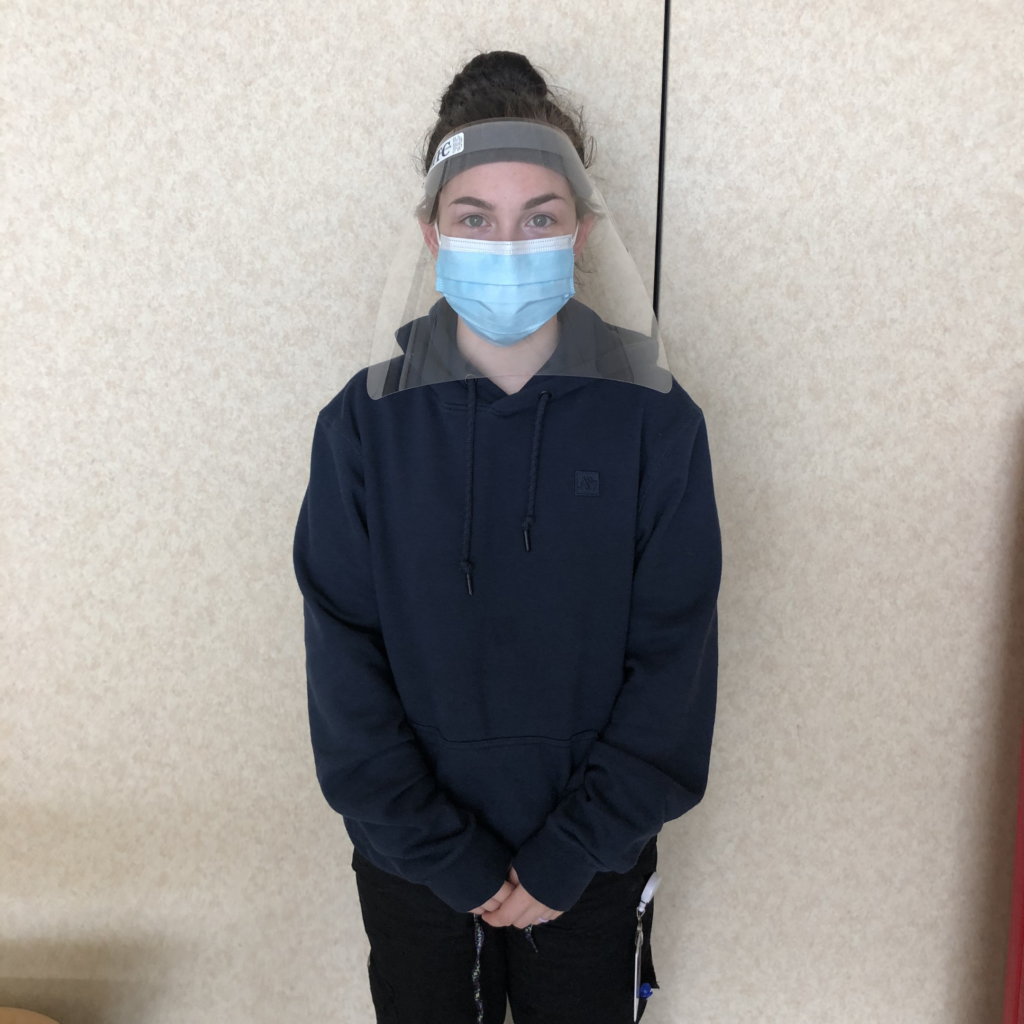
Photo of placement student, Aurora, donned in Personal Protective Equipment, which includes a blue dispoable face mask and a face shield.
OTA/PTA student, Aurora, donned in PPE

I have been at Grandview Kids for my placement since the beginning of January. I have been able to gain so much experience during my time with Grandview Kids. Even with personal protective equipment (PPE) and the safety added for everyone, I have been able to get a great learning experience with Grandview Kids.

Written by Grandview Kids CEO, Lorraine Sunstrum-Mann


It’s been one year since the World Health Organization (WHO) declared the COVID-19 outbreak a “pandemic.” That was the day everything changed. The federal government has declared March 11, 2021 as a National Day of Observance to commemorate the people who lost their lives due to novel coronavirus and the significant impacts it’s had on all Canadians.

The first reported case of COVID-19 in Ontario was January 25, 2020.  On March 12, public schools were ordered to close for two weeks following March Break. Grandview Kids closed our centres on March 14. On March 17, a state of emergency was declared in Ontario. Closure of all non-essential businesses was ordered on March 23. By March 31, all provincial parks and outdoor amenities were closed, and it was announced that schools would be closed until the end of May, subsequently extended for the remainder of the school year. Grandview Kids restricted access to urgent and critical services only, began to offer virtual services and would not re-open for in-person services until September 2020 (read more here).

Everyone was asked to stay home and not visit friends or extended family. Shops were forced to close their doors and layoff employees. People and businesses scrambled to secure personal protective equipment (PPE) as global demand quickly exceeded available supply. Our teams worked around-the-clock to figure out how Grandview Kids would still be able to operate, knowing thousands of clients and their families were relying on us.

We thought maybe this was just temporary, and that we would all be “back to normal” soon. How untrue this sentiment would prove to be.

In the year that’s unfolded since COVID-19 entered our daily conversations, Grandview Kids has experienced much change and uncertainty. The pandemic has affected our personal lives and our daily work.

We cannot discount the detrimental toll the pandemic has had on our community at large, with public health measures designed to protect our physical health, leading to a deterioration in our collective mental health.

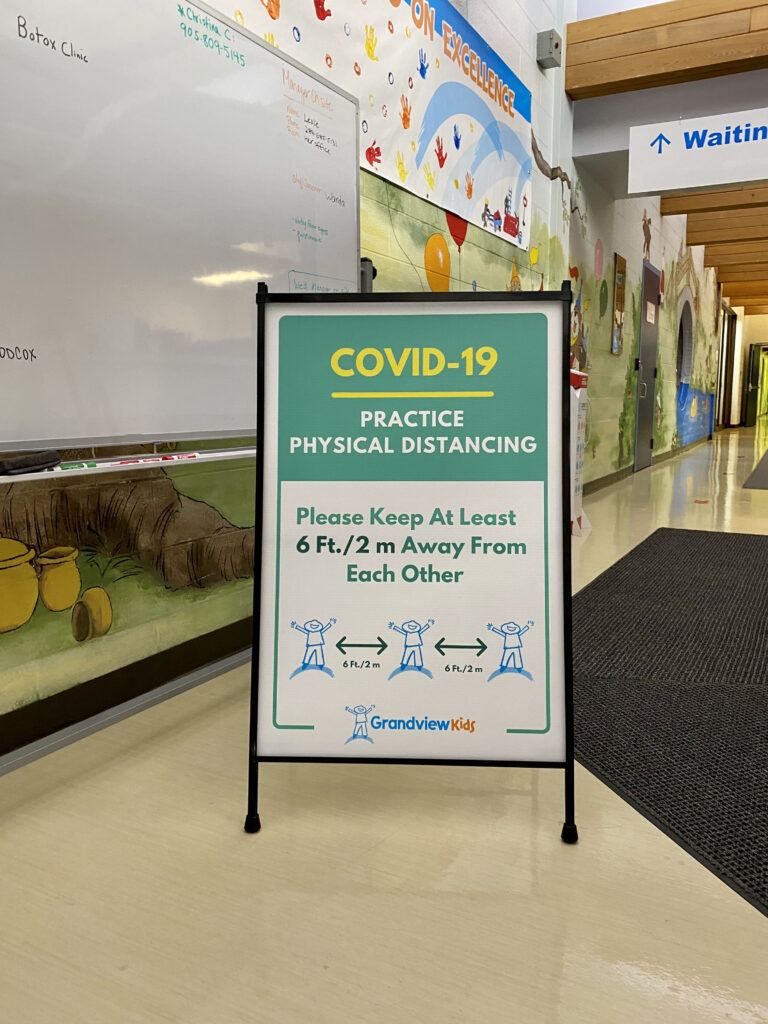
COVID-19 physical distancing guidelines displayed at the entrance of the Grandview Kids Main Site in Oshawa.

COVID-19 has undeniably brought about much despair. We miss our friends and family. We long for freedom to travel locally, domestically and abroad. Essential workers have tirelessly “showed up” to ensure our basic needs are met. Loves ones have died alone. Businesses have closed down – some forever. Thousands of people have lost their jobs. The economy is struggling. Kids and teens are longing for human interaction. Parents are exhausted, balancing work commitments, family responsibilities and virtual learning. It has not been easy. But through these seemingly insurmountable obstacles, we have prevailed – as a society, as Team Grandview.

The pandemic was also a powerful catalyst for positive change. It forced many people to slow down and take stock of their health and priorities. Organizations began to offer flexible work arrangements, overhauling the traditional workplace structures that had limited so many for decades. Rapid innovations in technology and medicine occurred. Communities rallied together. Human rights issues were propelled to the forefront. COVID-19 ushered in a time of unprecedented global change, unmatched in our lifetime.

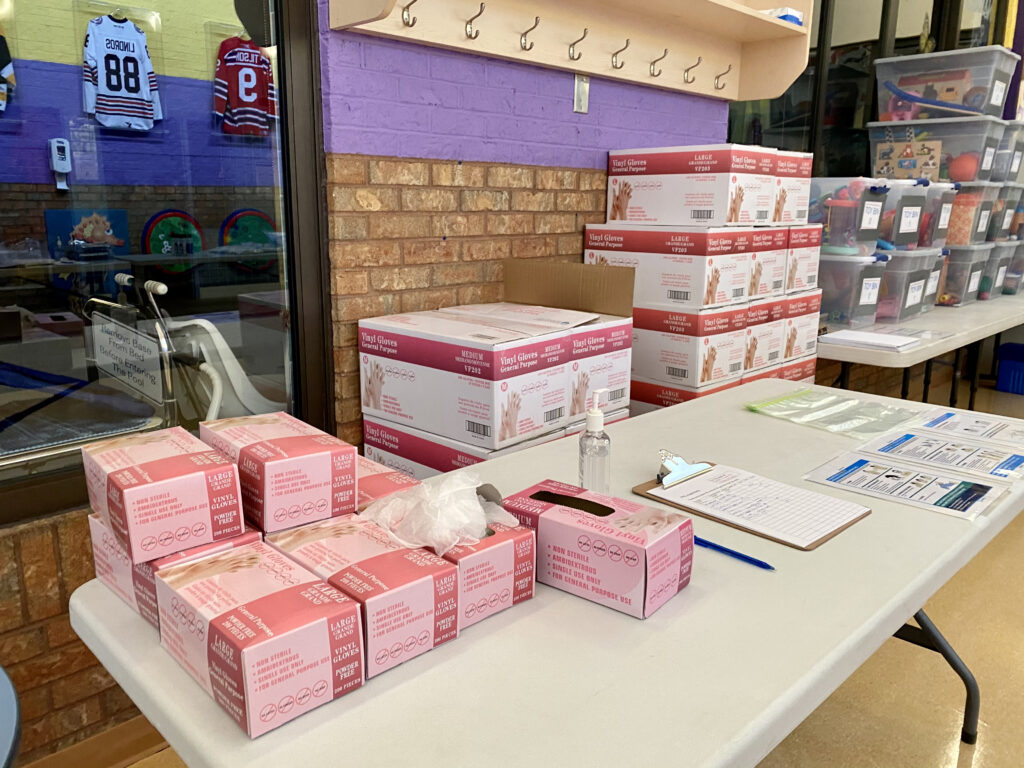
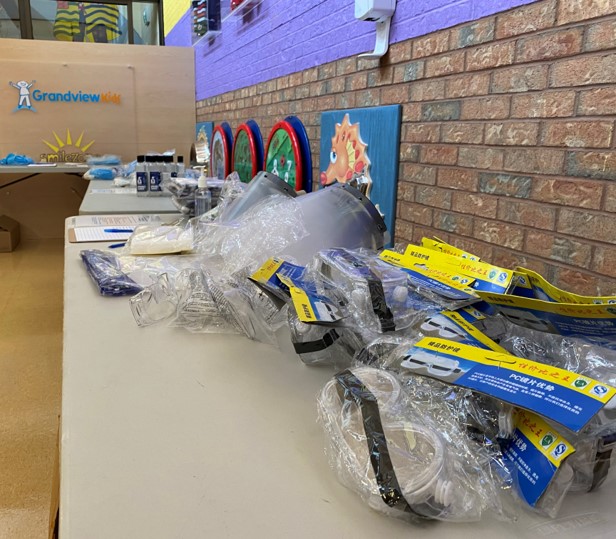
Available PPE ready to be checked-out by Grandview Kids staff.

Because of COVID… we accelerated our adoption of virtual care practices. Since March 2020, we have delivered nearly 24, 000 virtual visits to clients (compared to three the year prior)! While the uptake was challenging, requiring a massive undertaking to enhance our technology infrastructure, telepractice meant we could keep caring for the children and youth who needed us.

Because of COVID…we challenged outdated policies and procedures to modernize our care approach, embedding extensive pandemic safety protocols. We are proud to report zero workplace COVID-19 transmissions or outbreaks.

Because of COVID… we harnessed all the power and passion that is “Team Grandview” to respond and recover.

Because of COVID… we re-defined our future, to which we have arrived. I cannot thank our dedicated staff and volunteers enough, across all roles and disciplines, for their unwavering commitment and compassion since the COVID-19 health crisis began. I am privileged to lead this team. We got through this – together. The Grandview Way.

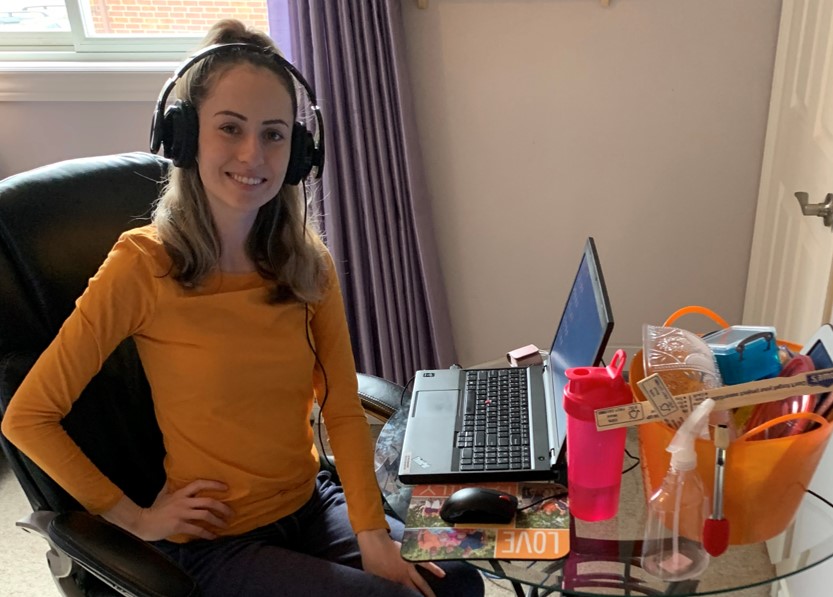
Grandview Kids staff member posing and smiling at desk while working from home
Grandview Kids staff member working from home.

Now, to look ahead….

Thinking beyond the pandemic

When I think about how far we have come and where we are going, the words “recovery and resilience” come to mind. COVID-19 consumed us, but it didn’t break us. We are moving into recovery. We will talk more about a recovery framework for Grandview Kids in the weeks ahead. 

We have fostered incredible resilience as individuals, as a community, and as an organization in response to COVID-19; this learning will continue for many years to come as the residual effects of the pandemic become more apparent.

A series of research studies recently published have shed light on the disproportionate impact of COVID-19 on children with disabilities and their families – the people we serve and support at Grandview Kids.

  • 70% school-aged children and youth surveyed in Ontario had their mental health harmed during the first wave of the pandemic between April and June 2020.1
    • Children in general fared worse across six domains of mental health — depression; anxiety; irritability; attention span; hyperactivity; and obsessions or compulsions. 1
    • Children with Autism Spectrum Disorder (ASD) reported the greatest deterioration in depression, irritability, attention span and hyperactivity. 1
  • In a survey of adults with disabilities or parents to children with disabilities, almost all respondents were worried about: catching COVID-19, friends and family, becoming seriously sick, being bored, getting food.2
    • Many respondents (60%) said these four important needs are not being met: leisure and recreation programs, emotional counselling, peer support, transportation.2
    • Most respondents (82%) said the pandemic has hurt their mental health.2
    • Most adults with disabilities (80%) also said they are more isolated and lonelier.2
    • People with disabilities are more likely to be isolated during the pandemic than other people.2
    • Over half of parents or caregivers said that their child with a disability gets less exercise during the pandemic.2
    • Over 40% said that their child’s eating habits have become worse.2
  • In a national survey, many parents reported that they were concerned about their children’s social engagement.3
    • Almost three-quarters of participants (71%) were very or extremely concerned about their children’s opportunities to socialize with friends, and more than half (54%) of participants were very or extremely concerned about their children’s loneliness or social isolation.3
    • Turning to parents’ concerns about their families, their top concern was about balancing child care, schooling and work, with 74% of participants reporting feeling very or extremely concerned in this regard.3
  • In a national survey about at-home learning during the pandemic, a higher proportion of participants whose family included a child with a disability reported being very or extremely concerned about their child’s academic success.4
  • A study conducted by Public Health Ontario revealed that the reduction in outdoor activities, free play and social interactions may be associated with an increase in children’s depressive symptoms, anxiety, irritability, boredom and stress. These effects are in addition to potential financial stressors, such as unemployment and loss of income in families due to the pandemic.5
    • Evidence shows community-based public health measures implemented in response to COVID-19 may be negatively affecting factors related to children’s healthy growth and development. 5
    • Reported effects of the COVID-19 public health response so far have been decreased vaccination coverage, decreased movement behavior, impacts on nutrition (e.g., low physical activity, poor diet, increased screen time and sedentary behavior) and on children’s mental health. 5

We cannot ignore this data. As a trusted service provider for families throughout Durham Region, we need to continue to offer the quality care expected of us, while considering how to adapt our offerings to meet new needs in our community – attributed to the fallout of COVID-19. We have much work to do. We are committed to ensuring the voices of clients and caregivers are captured in our recovery planning. And we are committed to ensuring the wellness and success of our staff in our recovery work ahead.

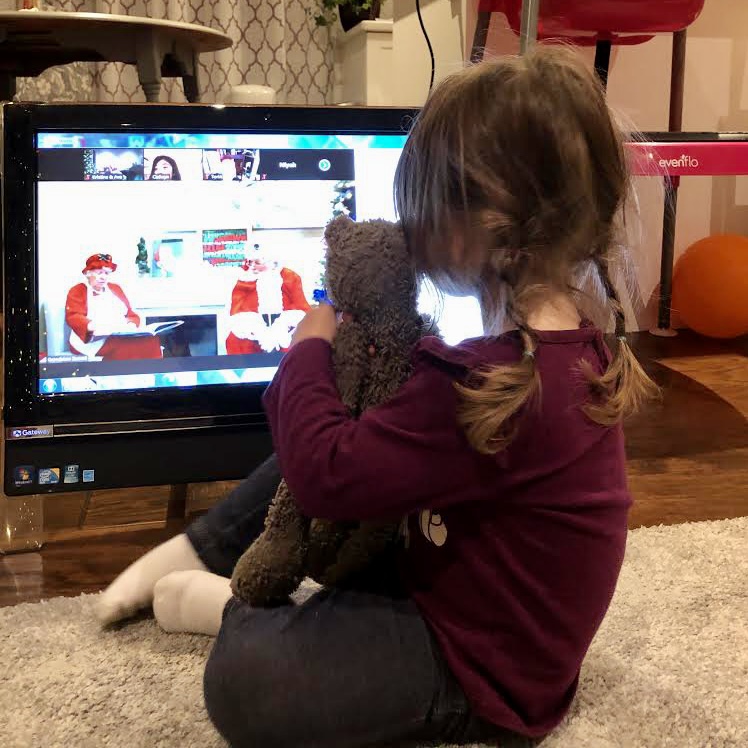
Little girl holding her stuffed animal close to her, sits in front of her computer on Zoom with Santa and Mrs. Claus.
Grandview Kids child visiting Santa virtually this year instead of in-person due to the physical distancing measures.

Throughout the pandemic, families told us we were their “lifeline.” When everything else seemed chaotic, and all sense of normalcy was lost, counting on a visit or appointment with Grandview Kids created a sense of support and routine so many people longed for. This fills us with pride. Now we must endeavour to keep the momentum going, one year later, one year after COVID-19  “took over.”

We must reclaim all that we strive for at Grandview Kids. Our recovery will lead to our resurgence. And, by 2024, when we move into the “New Grandview Kids” – we will emerge stronger amid the true renaissance of Grandview Kids.


References:

  1. Cost, K.T., Crosbie, J., Anagnostou, E. et al. Mostly worse, occasionally better: impact of COVID-19 pandemic on the mental health of Canadian children and adolescents. Eur Child Adolesc Psychiatry (2021). https://doi.org/10.1007/s00787-021-01744-3
  2. Abilities Centre and The Canadian Disability Participation Project. (2021). COVID-19 Disability Survey. https://abilitiescentre.org/Abilities/media/Documents/Covid-survey-report-Dec-18_1.pdf
  3. Findlay, L., & Arim, R. (2020, July). The impact of the COVID-19 pandemic on Canadian families and children. (The Daily).
  4. Greenlee, E., & Reid, A. (2020). Parents supporting learning at home during the COVID-19 pandemic. Statistics Canada Catalogue No. 45-28-0001 2020001 no. 00040. Statistics Canada. Ottawa.
  5. Public Health Ontario (2021). Negative impacts of community-based public health measure during pandemic on children and families.

Additional articles of interest:

  • COVID-19 complex needs parenting – CBC News
  • Most Ontario children faring worse during COVID-19, but some are doing better, Sick Kids study says – Toronto Star
  • Left out: Children and youth with special needs in the pandemic – BC Representative for Children and Youth
  • Ottawa, Canada marks one year of the COVID-19 pandemic – CTV News

As the world continues to adjust and adapt to our new normal in the wake of COVID-19, people across communities still face much adversity and uncertainty. For children and youth with disabilities and their families, the effects of the pandemic are far more exacerbated and devastating. The British Columbia Representative for Children and Youth’s December 2020 report, Left Out, revealed how COVID-19 disproportionally affected families of children and youth with special needs. The report reinforced the need to keep disabled children not only physically safe, but also look after their psychological and emotional wellbeing.

For 67 years, Grandview Kids has provided specialized programs, outpatient clinical treatment, and support to thousands of children and youth and their families with physical, communication and developmental needs and their families. We see first-hand, every day how crucial early and continuous intervention is to help these children and youth live life to their full potential. When COVID-19 forced our society to shut down in March 2020, Grandview Kids worried about the impact on clients we serve. For many families, Grandview Kids is a lifeline, there to support and guide them during challenging and emotional times throughout their child’s development.

Personal Protective Equipment (PPE) laid out on a table for Grandview Kids staff to access
PPE laid out for staff to use at the Grandview Kids Main Site in Oshawa.

We closed our sites in March 2020 when little was known about the COVID-19 virus. We nimbly responded, moving services online to offer clients virtual appointments. Dedicated teams worked to secure Personal Protective Equipment (PPE) and supplies for staff, while also implementing a series of evidence-based Infection Prevention and Control (IPAC) protocols to keep clients, families and staff safe when we were ready to re-open for in-person services.

Some Grandview Kids clients with complex needs continued to receive safe, effective in-centre care from our committed clinical and medical teams early on in the pandemic. In September 2020, we safely re-opened five of our eight locations for in-person appointments. Some sites could not accommodate our enhanced pandemic protocols, so they remain closed.

When planning to re-open, Grandview Kids’ top priority was safety, but we could not discount the risk to families the longer we stayed closed for in-person services. We acted quickly to make sure we could be there to fill some of the significant gaps in in our clients’ lives, which had been created by the pandemic.

Lorraine Sunstrum-Mann, Chief Executive Officer, Grandview Kids
Grandview Kids staff member posing and smiling at desk while working from home
Grandview Kids staff member working from home.

Maintaining a routine induces a sense of discipline as well as safety in children, which is important for their psychological and emotional development. Making adjustments to routines, such as experiencing school closures, social distancing and/or confinement to home, can prove to be a real struggle for children with physical and mental disabilities (Bartlett et al., 2020). Disrupting access to these children’s Grandview Kids therapists and services would only aggravate the problem.

When considering the populations Grandview Kids serves, challenges of online learning coupled with a lack of at-home recreational activities can prove to be frustrating for children with physical disabilities. Furthermore, developing social skills and social interaction is one of the hardest issues for children with Autism Spectrum Disorder (ASD) (Hills, 2020).

We have witnessed many families in crisis since COVID-19 took over our lives, as supports for their children were impacted while service providers figured out a response plan. While the fallout continues, the adverse effects on children’s health and wellbeing increases every day, making access to agencies like ours even more critical.

Dr. Carolyn Hunt, Medical Director, Grandview Kids

Grandview Kids’ safe-re-opening strategy means that these families were once again connected to the life-changing care they had come to rely on. It has been a learning experience for Grandview Kids teams, but they are united in a shared purpose to continue offering the quality, compassionate care that families have come to know and expect from Grandview Kids.

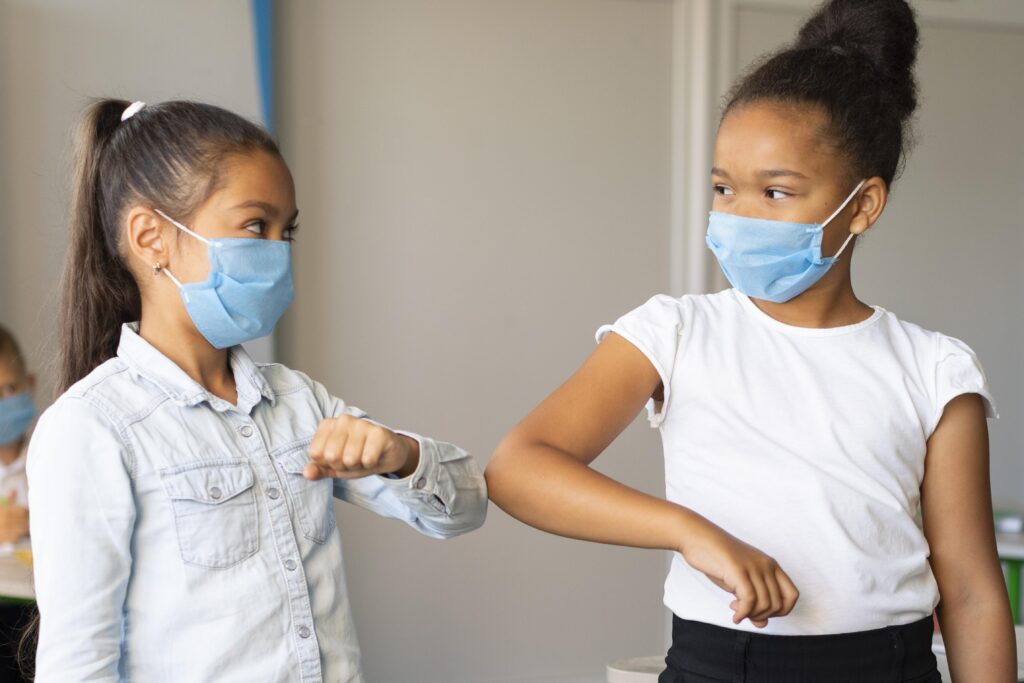
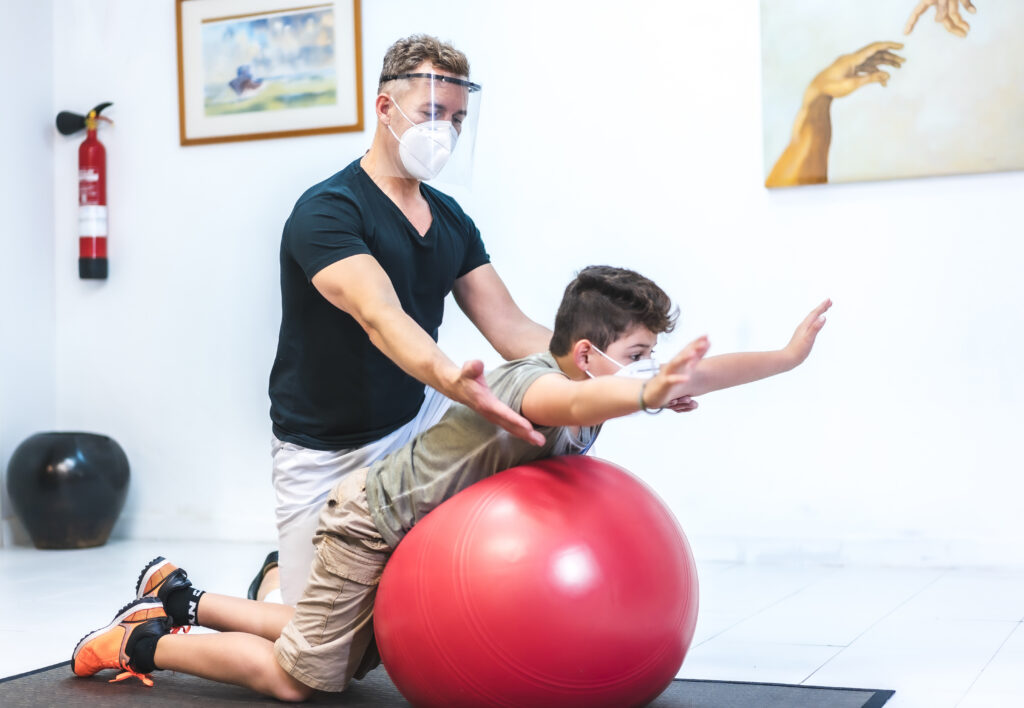
Physiotherapist with mask and screen stretching a child on a ball. Safety measures of physiotherapists in the Covid-19 pandemic. Osteopathy, therapeutic chiromassage
Child receiving physiotherapy treatment.

Grandview Kids continues to innovate its service delivery approach in response to COVID-19. We offer virtual sessions across programs and disciplines, as well as in-person appointments, appreciating some families and children prefer face-to-face interactions, while some therapies and assessments are not conducive to telepractice.

Despite the pandemic, demand for our paediatric medical and rehabilitation services continues to grow across Durham Region, exceeding 19,000 children and youth every year. Backed by the ongoing support of our local community, Grandview Kids remains committed to delivering exceptional services to families who need us, especially as we look ahead to beginning construction on our new Centre of Excellence and headquarters in Ajax.

References:

Bartlett J.D., Griffin J., Thomson D., 2020. Resources for supporting children’s emotional wellbeing during the COVID-19 pandemic. Child Trends. Retrieved from: https://www.childtrends.org/publications/resources-for-supporting-childrens-emotional-well-being-during-the-covid-19-pandemic 

Charlesworth, J., Representative for Children and Youth (2020). Left out: Children and youth with special needs in the pandemic. Retrieved from: https://rcybc.ca/wp-content/uploads/2020/12/CYSN_Report.pdf Hills F. The Atlantic; 2020. The Pandemic is a Crisis for Students with Special Needs. Retrieved from: https://www.theatlantic.com/education/archive/2020/04/special-education-goes-remote-covid-19-pandemic/610231/

  • ⟨
  • Page 1
  • Interim pages omitted …
  • Page 12
  • Page 13
  • Page 14
  • Page 15
  • Page 16
  • Interim pages omitted …
  • Page 35
  • ⟩

Primary Sidebar

Child Stories

LnRiLWZpZWxke21hcmdpbi1ib3R0b206MC43NmVtfS50Yi1maWVsZC0tbGVmdHt0ZXh0LWFsaWduOmxlZnR9LnRiLWZpZWxkLS1jZW50ZXJ7dGV4dC1hbGlnbjpjZW50ZXJ9LnRiLWZpZWxkLS1yaWdodHt0ZXh0LWFsaWduOnJpZ2h0fS50Yi1maWVsZF9fc2t5cGVfcHJldmlld3twYWRkaW5nOjEwcHggMjBweDtib3JkZXItcmFkaXVzOjNweDtjb2xvcjojZmZmO2JhY2tncm91bmQ6IzAwYWZlZTtkaXNwbGF5OmlubGluZS1ibG9ja311bC5nbGlkZV9fc2xpZGVze21hcmdpbjowfQ==
LnRiLWhlYWRpbmcuaGFzLWJhY2tncm91bmR7cGFkZGluZzowfQ==
ICAudGItaW1hZ2V7cG9zaXRpb246cmVsYXRpdmU7dHJhbnNpdGlvbjp0cmFuc2Zvcm0gMC4yNXMgZWFzZX0ud3AtYmxvY2staW1hZ2UgLnRiLWltYWdlLmFsaWduY2VudGVye21hcmdpbi1sZWZ0OmF1dG87bWFyZ2luLXJpZ2h0OmF1dG99LnRiLWltYWdlIGltZ3ttYXgtd2lkdGg6MTAwJTtoZWlnaHQ6YXV0bzt3aWR0aDphdXRvO3RyYW5zaXRpb246dHJhbnNmb3JtIDAuMjVzIGVhc2V9LnRiLWltYWdlIC50Yi1pbWFnZS1jYXB0aW9uLWZpdC10by1pbWFnZXtkaXNwbGF5OnRhYmxlfS50Yi1pbWFnZSAudGItaW1hZ2UtY2FwdGlvbi1maXQtdG8taW1hZ2UgLnRiLWltYWdlLWNhcHRpb257ZGlzcGxheTp0YWJsZS1jYXB0aW9uO2NhcHRpb24tc2lkZTpib3R0b219IC53cC1ibG9jay1pbWFnZS50Yi1pbWFnZVtkYXRhLXRvb2xzZXQtYmxvY2tzLWltYWdlPSJhMWJlMmUyODAwMWFkMGRlMjBhM2RlZWVlYmE5MDJhMSJdIHsgbWF4LXdpZHRoOiAxMDAlOyB9IEBtZWRpYSBvbmx5IHNjcmVlbiBhbmQgKG1heC13aWR0aDogNzgxcHgpIHsgICAudGItaW1hZ2V7cG9zaXRpb246cmVsYXRpdmU7dHJhbnNpdGlvbjp0cmFuc2Zvcm0gMC4yNXMgZWFzZX0ud3AtYmxvY2staW1hZ2UgLnRiLWltYWdlLmFsaWduY2VudGVye21hcmdpbi1sZWZ0OmF1dG87bWFyZ2luLXJpZ2h0OmF1dG99LnRiLWltYWdlIGltZ3ttYXgtd2lkdGg6MTAwJTtoZWlnaHQ6YXV0bzt3aWR0aDphdXRvO3RyYW5zaXRpb246dHJhbnNmb3JtIDAuMjVzIGVhc2V9LnRiLWltYWdlIC50Yi1pbWFnZS1jYXB0aW9uLWZpdC10by1pbWFnZXtkaXNwbGF5OnRhYmxlfS50Yi1pbWFnZSAudGItaW1hZ2UtY2FwdGlvbi1maXQtdG8taW1hZ2UgLnRiLWltYWdlLWNhcHRpb257ZGlzcGxheTp0YWJsZS1jYXB0aW9uO2NhcHRpb24tc2lkZTpib3R0b219IH0gQG1lZGlhIG9ubHkgc2NyZWVuIGFuZCAobWF4LXdpZHRoOiA1OTlweCkgeyAgIC50Yi1pbWFnZXtwb3NpdGlvbjpyZWxhdGl2ZTt0cmFuc2l0aW9uOnRyYW5zZm9ybSAwLjI1cyBlYXNlfS53cC1ibG9jay1pbWFnZSAudGItaW1hZ2UuYWxpZ25jZW50ZXJ7bWFyZ2luLWxlZnQ6YXV0bzttYXJnaW4tcmlnaHQ6YXV0b30udGItaW1hZ2UgaW1ne21heC13aWR0aDoxMDAlO2hlaWdodDphdXRvO3dpZHRoOmF1dG87dHJhbnNpdGlvbjp0cmFuc2Zvcm0gMC4yNXMgZWFzZX0udGItaW1hZ2UgLnRiLWltYWdlLWNhcHRpb24tZml0LXRvLWltYWdle2Rpc3BsYXk6dGFibGV9LnRiLWltYWdlIC50Yi1pbWFnZS1jYXB0aW9uLWZpdC10by1pbWFnZSAudGItaW1hZ2UtY2FwdGlvbntkaXNwbGF5OnRhYmxlLWNhcHRpb247Y2FwdGlvbi1zaWRlOmJvdHRvbX0gfSA=

Diwali (Festival of Lights) – November 12

Diwali, also known as Deepavali, is a festival of lights celebrated by many people all around the world. Based on the Hindu lunar calendar, Diwali will be celebrated on November...

Latest Updates

  • Celebrating Ahaana: Finding sound, strength and community on Cochlear Implant Day  January 30, 2026
  • Navigating the intersection of disability and race as a caregiver: Honouring Black History Month January 30, 2026
  • Embracing hope through every challenge: Brock’s journey January 30, 2026
  • Jack’s resilience shines through every step: Rare Disease Day January 30, 2026
  • February: Dates of Significance January 29, 2026

You Have Questions

We’d like to help you find the answers…

Contact Us Today

© Grandview Kids Built by PeaceWorks

  • About Us
  • Contact Us
  • Privacy
Accessibility Adjustments

Powered by OneTap

How long do you want to hide the toolbar?
Hide Toolbar Duration
Select your accessibility profile
Vision Impaired Mode
Enhances website's visuals
Seizure Safe Profile
Clear flashes & reduces color
ADHD Friendly Mode
Focused browsing, distraction-free
Blindness Mode
Reduces distractions, improves focus
Epilepsy Safe Mode
Dims colors and stops blinking
Content Modules
Font Size

Default

Line Height

Default

Color Modules
Orientation Modules