• Skip to primary navigation
  • Skip to main content
  • Skip to primary sidebar
Grandview Kids Logo

Grandview Kids

Every Child And Youth Living Life At Their Full Potential

  • About Us
    • Vision, Mission and Values
    • The New Grandview Kids
      • Operational Readiness
      • Visiting Grandview Kids’ Ajax Headquarters
    • Our History
    • Leadership
    • Board of Directors and Committees
      • Join our Board of Directors and Committees
    • Annual Report
    • Strategic Plan
    • Policies
  • Calendar
  • Annual Report
    • Strategic Direction 1: Deliver meaningful, efficient client and caregiver outcomes and experiences
    • Strategic Direction 2: Foster a thriving, connected Team Grandview
    • Strategic Direction 3: Collaborate with partners to maximize impact, focusing on Durham Region
    • The New Grandview Kids – The Jerry Coughlan Building
    • 2024-25 Financial Statement
    • Grandview Kids Foundation update
    • Grandview School update
  • Contact
    • Contactez – nous
    • Ajax – Headquarters
    • Bowmanville Health Centre
    • Grandview School
    • Oshawa – Dwyer
    • Port Perry
    • Whitby – Abilities Centre
  • Careers
  • Register
  • Donate
  • Instagram
  • LinkedIn
  • Facebook
  • Services and Programs
    • Audiology
    • Autism Program
      • Autism Spectrum Disorder (ASD) Diagnostic Hub
      • Caregiver-Mediated Early Years Programs
      • OAP Core Clinical Services
      • Entry to School Program
      • Foundational Family Services
    • Blind-Low Vision Program
    • Extensive Needs Service
    • Family Engagement Program
      • Adolescent Transition Program
      • Family Leader Program
        • Family Advisory Council
        • Youth Advisory Council
    • Infant Hearing Program
    • Medical Services
      • Autism Spectrum Disorder (ASD) Diagnostic Hub
      • Complex Care Program
      • Grandview Anesthesia Procedure (GAP) Clinic
      • Hypertonia Clinic
      • Nutrition Services
      • Orthopaedic Clinic
    • Occupational Therapy
    • Physiotherapy
    • Preschool Outreach Program
    • School Programs & Resources
      • Resources for Educators
      • School-Based Rehabilitation
    • Service Navigation
      • SmartStart Hub: Parents
      • SmartStart Hub: Partners
    • Social Work
    • Speech-Language Pathology
      • Augmentative and Alternative Communication
    • Therapeutic Recreation
  • Purchased Services
    • Beyond the Walls
    • Summer Camp 2026
    • OAP Core Clinical Services
      • Behaviour Services
  • Research
    • Get involved in research
    • IDEA Study
      • Building knowledge and understanding of the intersection of race and disability in accessing pediatric rehabilitation services.
    • Research Associate: Dr. Fiona Moola
    • Research Associate: Dr. Meghann Lloyd
  • Resources
    • Ability Acceptance Program
    • Arriving at Grandview Kids
    • Community Supports & Resources
    • Family Support Fund
    • Free to Read Program
    • Frequently Asked Questions
    • Gather by Grandview Kids
    • News and Updates
    • Privacy
    • Resources for Parents and Caregivers
    • Visiting Grandview Kids
  • Support Us
    • 50/50 Lottery
    • Ways to support
    • Host a fundraiser
    • Participate in an event
      • Golf Fore Grandview Kids
      • Sponsor the Drum
      • Dream Big, Dream Brighter Awards Gala
    • Leave a legacy
      • Gifts of securities
      • Gifts of bequests
      • Gifts of life insurance
    • Your impact
    • Building a Legacy: Honouring Jerry Coughlan
  • I Want To…
    • Connect with Grandview Kids
    • Donate
    • Refer a child or youth
    • Register via My Community Hub
    • Schedule an Appointment
    • Volunteer at Grandview Kids
    • Work at Grandview Kids
  • Grandview School
    • About Our Program
    • About Our Board
    • Grandview School Social Story
    • Plans and Reports
    • Resources for Families
    • Resources for Schools – Switch It Up!
    • Careers and Volunteering
    • Contact Grandview School
  • Search

Posted July 12, 2021

Develop your child’s social skills through play

Therapeutic Recreation

Written by Grandview Kids Recreation Therapist, Maddy

Many social skills are developed through play in early childhood. Teaching your child to play and engage with their peers will help them develop friendships and build skills to develop meaningful leisure interests. Grandview Recreation Therapist, Maddy, has created some activity and game suggestions that you can do with your children to encourage social skills and peer-to-peer social communication.


Illustration of three kids jumping on a sandy beach.

These activities and games can be done with siblings, neighbours, and/or other peers close in age to your child. These activities will provide caregivers with an opportunity to encourage their child/children to develop appropriate social skills and peer-to-peer social communication.

Use variations and make modifications as needed.

Tips

  • Provide choices as often as possible.
  • Take breaks as needed.
  • Focus on the child’s strengths. Please encourage them to use their talents. At the same time, identify their challenges and find ways to work on them together.
  • Model how to play the game and use your own play and enthusiasm to promote engagement. You can use hand-over-hand support to help them understand what they need to do in the game.
  • Make sure to clarify when it is my turn vs. your turn. Can use pointing, words, or other visuals if helpful. Learning to take turns in play will support learning how to take turns in social conversations.

Activity List

  • I-Spy/Spot It
  • Play-Doh Guessing Game
  • Simon Says
  • Red Light Green Light
  • Fort Building

I-Spy/Spot It

This activity fosters turn-taking and is a game that requires no toys or equipment. This activity is commonly played in unstructured time with school-aged children.

  1. Use a picture, spot it books, or simply lookout around the room or out a window.
  2. You start by saying: “I spy with my little eye something that is *choose a colour*.”
  3. Wait for your child to guess and keep going until they guess the correct object. Your child can guess using words, pointing, leading, etc.
  4. Take turns going back and forth for as long as your child will tolerate. It may start at 2 minutes, and eventually, you may be able to play for 10-15.

Graphic of a red magnifying glass.

Play-Dough Guessing Game

This activity allows your child to practice theory of mind (the idea that not everyone knows what you know), turn-taking, and creativity.

  1. You will need play-dough or modelling clay. You can also use tools, shapes, cookie cutters, etc.
  2. At a table or flat surface, set out your play-dough. Give lots of choices (colours, tools, etc.).
  3. Set a time limit and tell your child you will make something specific (a food, an animal, a shape, a number, etc.); you can use a visual timer if needed.
  4. Emphasize that what they are making is a secret and that you are playing a guessing game (this can be a challenging concept for many children – practice as much as possible).
  5. When the objects are ready, take turns guessing what you each made.
  6. Can repeat with different categories, shapes, trade materials etc. While building, you can talk about the categories, shapes you’re making, taking turns with materials (“can I use the knife” or “what foods do we like to eat?”).
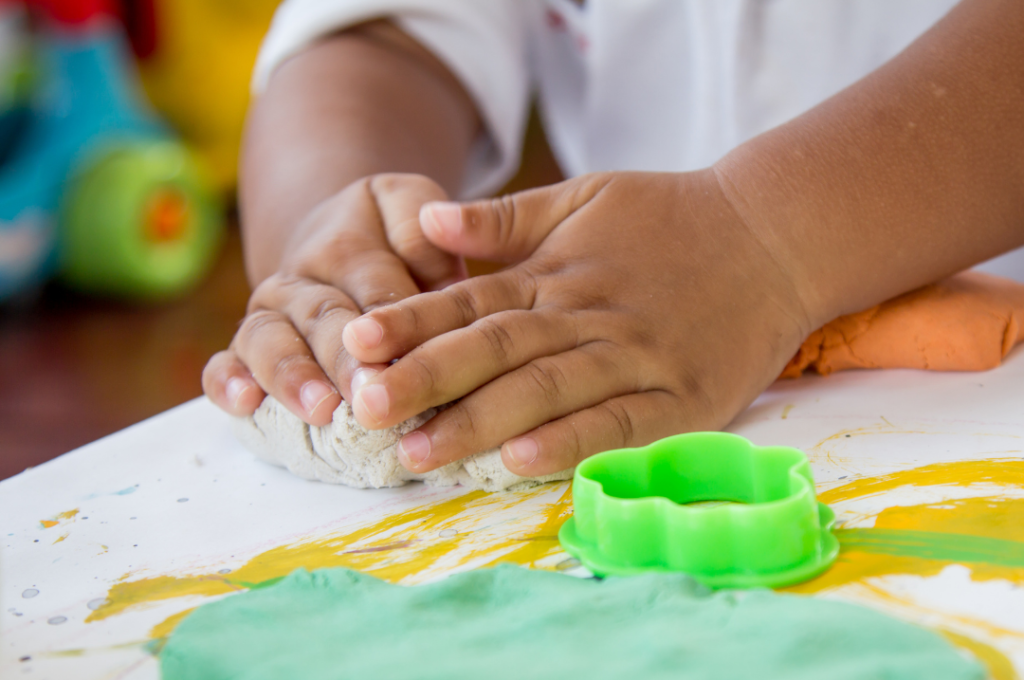
Image of a little child kneading play-dough.

Simon Says

This activity teaches skills commonly seen in group activities in school and recreation programs. Practicing at home might help develop their confidence in group settings.

  1. Explain to your child that you will take turns being “Simon” (it can be any character – Peppa Says, Skye Says, Ryder Says, etc., remember to follow their interests).
  2. Take turns just giving instructions and following the leader “touch your head, jump up and down, etc..”
  3. Once your child is comfortable, you can try adding the official rule; if you don’t start your sentence with “Simon Says,” you do not follow the action (this may be tricky for some children, be patient and practice).
  4. Then allow your child long turns being Simon!

Illustration of a group of kids cupping their ears to listen closely.

Red Light, Green Light

Red Light, Green Light is a great activity to play with a group. This activity helps teach self-regulation and body control in a fun and exciting way.

  1. Start by naming each light and the meaning of each light using modelling (red light = stop, green light = go, yellow light = slow).
  2. To start, you can find an open space and take turns yelling out each light colour.
  3. Once they understand this, you can choose one person to be ‘It.’ The person moves farther away and stands with their back towards the other players. The other players will stand on a line facing the person who is its back.
  4. The person who is it will start calling out “Green Light/Yellow Light” and will turn around and call “Red Light,” trying to catch other players moving.
  5. Take turns being the leader.
  6. If you don’t have a big space to participate in this activity – play on the spot (run on the spot, dance, slow motion on the spot, etc.)
  7. Once they understand the rules, you can add different coloured lights to the activity (purple light = dance, blue light = sit, etc.).

Picture of a black traffic light.

Fort Building

This activity will support pretend/imaginative play while using problem-solving to work cooperatively with you.

  1. This activity involves cooperative play skills, working together as parent and child or child and peer towards a common goal.
  2. Ask your child if the fort should have a theme (Lion’s Den, Mermaid cave, Zoo, house, doctor’s office, castle, etc.)
  3. Discuss what supplies should be used and what aspects of the structure you will need (walls, door, roof, etc.)
  4. Gather supplies together, use blankets, pillows, chairs, and other household items to build your fort
  5. Build a fort together, allow for trial and error, and encourage discussion throughout
  6. Foster continuation of ideas by repeating their statements back to them as questions
    • Your child says, “we need a door that can move,” you reply saying, “oh, we need one that moves?”. This will encourage them to continue their thought process out loud.
    • If they are replying with one-word answers (“yeah” or head nodding), try to elaborate by saying, “We need a door that moves? What could we use that moves?”
  7. Once your fort is built, engage in pretend play – either “house” or follow your child’s theme. Assign roles and play out various scenarios (going to bed, dinner time, getting ready for school, fighting a “bad guy,” etc.).

Illustration of dad and daughter reading a book with a flashlight underneath a homemade fort.

Written by Grandview Kids Recreation Therapists, Julia and Alicia


Whether it’s indoors or outside in the sun, the role of a sibling during play is extremely important to your child’s social development. In a time of limited social opportunities, siblings act as social partners and an opportunity for those important reciprocal interactions. Use this resource to find new ways to foster play between siblings at home with the toys and equipment that you may already have. It features helpful tips and activity examples in 4 different categories; turn-taking activities, pretend/imaginative play activities, manipulatives, and active games. The resource offers progressive steps in each category to enhance the social and play skills your child is developing. Sibling play has the ability to not only promote growth in a child’s ability to engage with others outside of the home, but it also enhances the life-long relationship between siblings themselves.

A sibling relationship is one of the first relationships your child will develop across the life-span. Sibling relationships are unique with differing effects on a child’s development and perception of the world. Siblings function as social partners and an opportunity to develop experience with reciprocal interaction, communication, and conflict resolution skills.

McHale, Updegraff & Feinberg, 2017

Tools for Success

  1. Encourage communication between siblings; have your child prompt their sibling to play: “come play with me”, “your turn”, sign “play”, or point to the activity
  2. Incorporate different types of activities to hold their interest, and understand when it is time to take a break (short activities, under 5 minutes are a good starting point)
  3. Provide each sibling with the chance to choose an activity
  4. Encourage parallel (side by side) play as much as possible to build tolerance of another child in their play area
  5. Make sure the activity matches the skill level of each participating child (a task that is too easy or too difficult with not be successful)
  6. Modify materials/set up when required if there is a large gap in abilities or ages (Example: smaller/larger blocks, different options for arts & crafts materials, implementation of movement breaks, etc)
  7. Celebrate all wins; encourage siblings to provide praise to each other (Example: high fives, or “Good Job”)
  8. Incorporate your child’s interests in the activities you choose, follow their lead as much as possible
  9. Choose activities where they work together to achieve a common goal (example: building one block tower vs. building independent towers side by side)
  10. If helpful, provide a schedule or timer for each set of planned activities

Finding ways for siblings to connect and engage with each other is crucial to the development of an enjoyable play experience and ongoing relationship. This resource will provide activity ideas and tips for facilitating sibling play and the development of this relationship.

Practice Activities

Turn-taking Activities

Step 1: Games requiring a tool e.g. Critter Clinic or anything with a set of keys, Don’t Break the Ice, Cariboo, pin the tail on the donkey, piñata, T-Ball, bowling (one ball), Operation

Step 2: Slot Games or games with multiple pieces. E.g. Kerplunk, Piggy Bank, Pop The Pig, Jenga, crocodile dentist, Sneaky Snacky Squirrel

Step 3: Games with rules or competition e.g., Connect 4, Guess Who, snakes and ladders, Monopoly, battleship, I Spy, Trouble

Pretend/Imaginative Play Activities

Step 1: Toys or Action Figures e.g. Potato Head, cars and trucks, farm animals, sea creatures, Paw Patrol, Barbies/LOL Dolls, superheroes

Step 2: Role-Playing e.g. build a fort and playhouse, doctor/patient, vet clinic, construction site, play-dough restaurant, tea party

Step 3: Games with rules or competition e.g. charades, Pictionary, sculptionary, Cranium, Cadoo

Manipulatives

Step 1: Parallel Play – have both children completing their own activities with their own pot, e.g. beading, play-dough, Mag-formers

Step 2: Associative Play – have each child complete their own activity, but pull from the same pot, for example build LEGO but have all the LEGO in one bucket

Step 3: Cooperative Play – complete an activity together e.g. build one tower together, work on a puzzle together, use a gears board

Active Games

Step 1: Structured games with both children playing actively e.g. obstacle course, dance videos, freeze dance, yoga, scavenger hunt

Step 2: Leader games e.g. Simon Says, follow the leader, Action If, trick shot basketball or bowling (take turns making up trick shots that the other person must complete)

Step 3: Competitive Games e.g. musical chairs, hide/seek, Activity Bingo, tag variation.

Grandview Kids Director of Clinical Services, Leslie Suite, commemorates National Therapeutic Recreation Month.

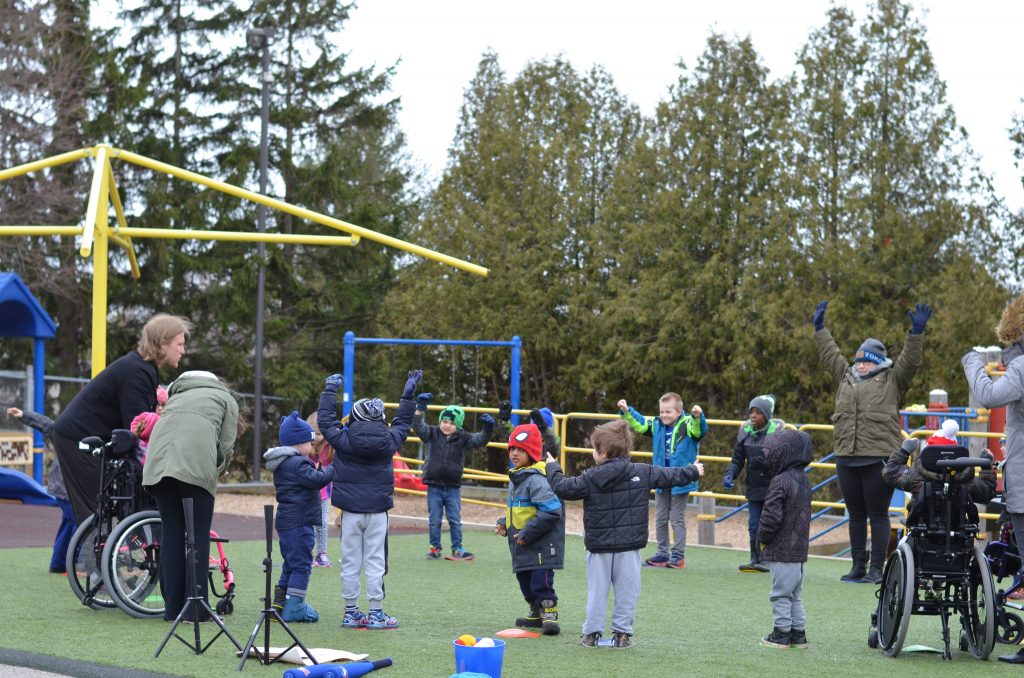
Grandview Kids Therapeutic Recreation outdoor play group.

I would like to take a moment to recognize the Grandview Kids Therapeutic Recreation team, as February is National Therapeutic Recreation Month. The Therapeutic Recreation team has taken on adversity over the last year with commendable poise.

Recreation Therapists (RTs) at Grandview Kids work with children, youth and families to improve physical, emotional and cognitive well-being through activity-based interventions. RT sessions can take place 1:1 or in group settings, virtually or in-person. RTs use play, recreation participation and leisure activities to support overall physical and mental health.

Normally, the Therapeutic Recreation (TR) staff offers a variety of social group activities. Some of these activities include preschool play groups, swimming lessons, Tae-Kwon-Do classes, physical literacy groups, Parasport programs and several more. Running these activities was a large part of the program’s day-to-day regimen and it is clear that families deeply miss this aspect of TR.

It is no secret that getting to work with clients, in groups, face-to-face, has always been at the core of the work RTs do. However, like everyone in 2020, the TR staff had to adjust to the new normal. They have recently expanded their team and were able to quickly adapt, beginning to offer tele-practice social groups, and continuing to offer 1:1 in-person sessions for clients who were unable to participate virtually. The TR team has worked determinedly to develop new games and activities to adhere to the new COVID protocols and parameters. Their work does not go unnoticed, as the time RTs dedicated to adapting their programs and creating new activities has only improved the day-to-day lives of the children and youth they serve. 

Thank you, to all of our RTs, for all that you do to help make Grandview Kids a welcoming environment and an adaptable point-of-care for all families and caregivers who visit us.

To learn more about what Recreation Therapy looks like at Grandview Kids, click here.

To learn more about the Canadian organizations that are supporting TR Awareness Month, please visit the links provided below:

  • The Canadian Therapeutic Recreation Association
  • Therapeutic Recreation Ontario

Sincerely,

Leslie Suite, Director of Clinical Services

Written by by Grandview Kids Recreation Therapist, Alicia (Discipline Lead)


If your family values recreation and leisure activities, or you are looking for ways to get your children active, the registration fees can be daunting, especially if you have a child who may require variation or a number of children with varying interests and abilities. Check out this chart to see if you are eligible for funding support through private organizations or through your municipality. There are many options for families who qualify for low-income, and there are some that are based on diagnosis only, which may not require proof of low income/financial hardship.

If you are considering Jumpstart funding, but do not quite meet the cutoff, contact your municipal contact and explain your current circumstance to see if they are able to approve your application in person. This decision is made based on available funds and family-specific circumstances.

Contact your Recreation Therapist or Service Navigation if you have questions.

Written by Grandview Kids Recreation Therapist – Discipline Lead, Alicia


Keeping your kids active is getting increasingly difficult with the current closures and the dropping temperatures. Check out these indoor obstacle course ideas to set up a fun physical activity in your living room!

All courses are made using furniture or items you already have at home. You can set them up as a relay (have you/your children take turns completing the course, and then giving the next person a high five to indicate that it is their turn), or time yourselves to make it competitive. Use painters’ tape to make a line course indoors, the rules are you must keep both feet on a line at all times.

Downloadable Obstacle Course PDFs:

1. Obstacle Course – IndoorDownload
2. Living Room Obstacle CourseDownload
3. Chalk Tape Obstacle CourseDownload

Welcome to the end of 2020! The focus this year has been on monitoring your family’s physical health and taking every precaution to protect it. Unfortunately, this means that we likely have been under a huge amount of stress. Safety measures and closures have resulted in the loss of many of the activities that help us unwind and connect with others. It is important to take some time at the end of the year to engage in activities that help us relax, reconnect, and recharge.


The Grandview Kids Therapeutic Recreation Team has put together a large Activity Package (31 pages!) for families to access throughout the Holidays and beyond! We hope that this package chock-full of activities helps keep your family busy and entertained.

Click the link below to download the package:

Grandview Kids Therapeutic Recreation Activity Package 2020Download
A graphic depicting a child playing with a hula-hoop that reads: "Grandview Kids Activity Package"
  • ⟨
  • Page 1
  • Page 2
  • Page 3
  • ⟩

Primary Sidebar

Child Stories

LnRiLWZpZWxke21hcmdpbi1ib3R0b206MC43NmVtfS50Yi1maWVsZC0tbGVmdHt0ZXh0LWFsaWduOmxlZnR9LnRiLWZpZWxkLS1jZW50ZXJ7dGV4dC1hbGlnbjpjZW50ZXJ9LnRiLWZpZWxkLS1yaWdodHt0ZXh0LWFsaWduOnJpZ2h0fS50Yi1maWVsZF9fc2t5cGVfcHJldmlld3twYWRkaW5nOjEwcHggMjBweDtib3JkZXItcmFkaXVzOjNweDtjb2xvcjojZmZmO2JhY2tncm91bmQ6IzAwYWZlZTtkaXNwbGF5OmlubGluZS1ibG9ja311bC5nbGlkZV9fc2xpZGVze21hcmdpbjowfQ==
LnRiLWhlYWRpbmcuaGFzLWJhY2tncm91bmR7cGFkZGluZzowfQ==
ICAudGItaW1hZ2V7cG9zaXRpb246cmVsYXRpdmU7dHJhbnNpdGlvbjp0cmFuc2Zvcm0gMC4yNXMgZWFzZX0ud3AtYmxvY2staW1hZ2UgLnRiLWltYWdlLmFsaWduY2VudGVye21hcmdpbi1sZWZ0OmF1dG87bWFyZ2luLXJpZ2h0OmF1dG99LnRiLWltYWdlIGltZ3ttYXgtd2lkdGg6MTAwJTtoZWlnaHQ6YXV0bzt3aWR0aDphdXRvO3RyYW5zaXRpb246dHJhbnNmb3JtIDAuMjVzIGVhc2V9LnRiLWltYWdlIC50Yi1pbWFnZS1jYXB0aW9uLWZpdC10by1pbWFnZXtkaXNwbGF5OnRhYmxlfS50Yi1pbWFnZSAudGItaW1hZ2UtY2FwdGlvbi1maXQtdG8taW1hZ2UgLnRiLWltYWdlLWNhcHRpb257ZGlzcGxheTp0YWJsZS1jYXB0aW9uO2NhcHRpb24tc2lkZTpib3R0b219IC53cC1ibG9jay1pbWFnZS50Yi1pbWFnZVtkYXRhLXRvb2xzZXQtYmxvY2tzLWltYWdlPSJhMWJlMmUyODAwMWFkMGRlMjBhM2RlZWVlYmE5MDJhMSJdIHsgbWF4LXdpZHRoOiAxMDAlOyB9IEBtZWRpYSBvbmx5IHNjcmVlbiBhbmQgKG1heC13aWR0aDogNzgxcHgpIHsgICAudGItaW1hZ2V7cG9zaXRpb246cmVsYXRpdmU7dHJhbnNpdGlvbjp0cmFuc2Zvcm0gMC4yNXMgZWFzZX0ud3AtYmxvY2staW1hZ2UgLnRiLWltYWdlLmFsaWduY2VudGVye21hcmdpbi1sZWZ0OmF1dG87bWFyZ2luLXJpZ2h0OmF1dG99LnRiLWltYWdlIGltZ3ttYXgtd2lkdGg6MTAwJTtoZWlnaHQ6YXV0bzt3aWR0aDphdXRvO3RyYW5zaXRpb246dHJhbnNmb3JtIDAuMjVzIGVhc2V9LnRiLWltYWdlIC50Yi1pbWFnZS1jYXB0aW9uLWZpdC10by1pbWFnZXtkaXNwbGF5OnRhYmxlfS50Yi1pbWFnZSAudGItaW1hZ2UtY2FwdGlvbi1maXQtdG8taW1hZ2UgLnRiLWltYWdlLWNhcHRpb257ZGlzcGxheTp0YWJsZS1jYXB0aW9uO2NhcHRpb24tc2lkZTpib3R0b219IH0gQG1lZGlhIG9ubHkgc2NyZWVuIGFuZCAobWF4LXdpZHRoOiA1OTlweCkgeyAgIC50Yi1pbWFnZXtwb3NpdGlvbjpyZWxhdGl2ZTt0cmFuc2l0aW9uOnRyYW5zZm9ybSAwLjI1cyBlYXNlfS53cC1ibG9jay1pbWFnZSAudGItaW1hZ2UuYWxpZ25jZW50ZXJ7bWFyZ2luLWxlZnQ6YXV0bzttYXJnaW4tcmlnaHQ6YXV0b30udGItaW1hZ2UgaW1ne21heC13aWR0aDoxMDAlO2hlaWdodDphdXRvO3dpZHRoOmF1dG87dHJhbnNpdGlvbjp0cmFuc2Zvcm0gMC4yNXMgZWFzZX0udGItaW1hZ2UgLnRiLWltYWdlLWNhcHRpb24tZml0LXRvLWltYWdle2Rpc3BsYXk6dGFibGV9LnRiLWltYWdlIC50Yi1pbWFnZS1jYXB0aW9uLWZpdC10by1pbWFnZSAudGItaW1hZ2UtY2FwdGlvbntkaXNwbGF5OnRhYmxlLWNhcHRpb247Y2FwdGlvbi1zaWRlOmJvdHRvbX0gfSA=
Grandview Kid 2-year-old Matteo smiling for the camera

Meet 2-Year-Old Matteo

Meet 2-year-old Grandview kid, Matteo! He is a smiley kid who loves animals (especially elephants), reading books and singing –– in particular, his favourite, Wheels on the Bus. Matteo has...

Latest Updates

  • Grandview Kids and Lakeridge Health open Canada’s first anesthesia procedure clinic in a Children’s Treatment Centre May 6, 2026
  • Ahaana’s magic ears: Speech and Hearing Month May 5, 2026
  • May: Dates of Significance April 30, 2026
  • Building confidence through the power of giving: Norah’s story April 30, 2026
  • A Place Where S Shines: Williams Syndrome Awareness Month April 29, 2026

You Have Questions

We’d like to help you find the answers…

Contact Us Today

© Grandview Kids Built by PeaceWorks

  • About Us
  • Contact Us
  • Privacy
Accessibility Adjustments

Powered by OneTap

How long do you want to hide the toolbar?
Hide Toolbar Duration
Select your accessibility profile
Vision Impaired Mode
Enhances website's visuals
Seizure Safe Profile
Clear flashes & reduces color
ADHD Friendly Mode
Focused browsing, distraction-free
Blindness Mode
Reduces distractions, improves focus
Epilepsy Safe Mode
Dims colors and stops blinking
Content Modules
Font Size

Default

Line Height

Default

Color Modules
Orientation Modules