• Skip to primary navigation
  • Skip to main content
  • Skip to primary sidebar
Grandview Kids Logo

Grandview Kids

Every Child And Youth Living Life At Their Full Potential

  • About Us
    • Vision, Mission and Values
    • The New Grandview Kids
      • Operational Readiness
      • Visiting Grandview Kids’ Ajax Headquarters
    • Our History
    • Leadership
    • Board of Directors and Committees
      • Join our Board of Directors and Committees
    • Annual Report
    • Strategic Plan
    • Policies
  • Calendar
  • Annual Report
    • Strategic Direction 1: Deliver meaningful, efficient client and caregiver outcomes and experiences
    • Strategic Direction 2: Foster a thriving, connected Team Grandview
    • Strategic Direction 3: Collaborate with partners to maximize impact, focusing on Durham Region
    • The New Grandview Kids – The Jerry Coughlan Building
    • 2024-25 Financial Statement
    • Grandview Kids Foundation update
    • Grandview School update
  • Contact
    • Contactez – nous
    • Ajax – Headquarters
    • Bowmanville Health Centre
    • Grandview School
    • Oshawa – Dwyer
    • Port Perry
    • Whitby – Abilities Centre
  • Careers
  • Register
  • Donate
  • Instagram
  • LinkedIn
  • Facebook
  • Services and Programs
    • Audiology
    • Autism Program
      • Autism Spectrum Disorder (ASD) Diagnostic Hub
      • Caregiver-Mediated Early Years Programs
      • OAP Core Clinical Services
      • Entry to School Program
      • Foundational Family Services
    • Blind-Low Vision Program
    • Extensive Needs Service
    • Family Engagement Program
      • Adolescent Transition Program
      • Family Leader Program
        • Family Advisory Council
        • Youth Advisory Council
    • Infant Hearing Program
    • Medical Services
      • Autism Spectrum Disorder (ASD) Diagnostic Hub
      • Complex Care Program
      • Grandview Anesthesia Procedure (GAP) Clinic
      • Hypertonia Clinic
      • Nutrition Services
      • Orthopaedic Clinic
    • Occupational Therapy
    • Physiotherapy
    • Preschool Outreach Program
    • School Programs & Resources
      • Resources for Educators
      • School-Based Rehabilitation
    • Service Navigation
      • SmartStart Hub: Parents
      • SmartStart Hub: Partners
    • Social Work
    • Speech-Language Pathology
      • Augmentative and Alternative Communication
    • Therapeutic Recreation
  • Purchased Services
    • Beyond the Walls
    • Summer Camp 2026
    • OAP Core Clinical Services
      • Behaviour Services
  • Research
    • Get involved in research
    • IDEA Study
      • Building knowledge and understanding of the intersection of race and disability in accessing pediatric rehabilitation services.
    • Research Associate: Dr. Fiona Moola
    • Research Associate: Dr. Meghann Lloyd
  • Resources
    • Ability Acceptance Program
    • Arriving at Grandview Kids
    • Community Supports & Resources
    • Family Support Fund
    • Free to Read Program
    • Frequently Asked Questions
    • Gather by Grandview Kids
    • News and Updates
    • Privacy
    • Resources for Parents and Caregivers
    • Visiting Grandview Kids
  • Support Us
    • 50/50 Lottery
    • Ways to support
    • Host a fundraiser
    • Participate in an event
      • Golf Fore Grandview Kids
      • Sponsor the Drum
      • Dream Big, Dream Brighter Awards Gala
    • Leave a legacy
      • Gifts of securities
      • Gifts of bequests
      • Gifts of life insurance
    • Your impact
    • Building a Legacy: Honouring Jerry Coughlan
  • I Want To…
    • Connect with Grandview Kids
    • Donate
    • Refer a child or youth
    • Register via My Community Hub
    • Schedule an Appointment
    • Volunteer at Grandview Kids
    • Work at Grandview Kids
  • Grandview School
    • About Our Program
    • About Our Board
    • Grandview School Social Story
    • Plans and Reports
    • Resources for Families
    • Resources for Schools – Switch It Up!
    • Careers and Volunteering
    • Contact Grandview School
  • Search

Posted April 14, 2020

Fun Feeding Activities for “Picky Eaters”

Adrian Polidano

Mealtimes can be stressful for a lot of families, especially for any family that has a “picky eater”. Thankfully there are many ways we can help kids learn to love new foods in fun and playful ways. During food play and food exploration the focus should be on fun and engagement, therefore we should not expect our kids to eat during this time.

Grandview Kids Occupational Therapists Pamela and Samantha have some ideas to get your family started on the path to loving food exploration!

  • Build a mashed potato volcano with peas as rocks
  • Make a log cabin with carrots and other vegetable sticks as the “logs”
  • Engage in a stamping craft using cut fruits and vegetables as the “stamps” and pudding or fruit sauce as the “paint”
  • Painting with food – try yogurt, pudding, pasta sauce, or apple sauce. If your child can tolerate it, have them paint with their fingers (you may even get a lick!). If they are unsure about finger painting, you can use a paintbrush.
  • Car wash – Driving cars through “mud” (whipped cream, apple sauce, or pudding) on a cookie tray, then use a spray bottle with water to “take them through the car wash” afterwards
  • Create robots using toothpicks and various small fruits and vegetables (e.g., strawberries, baby carrots, grape tomatoes, grapes, etc.) as that various robot pieces and the toothpicks to join the pieces
  • Make housing and castle structures out of grapes and/or marshmallows and toothpicks
  • Make a food scavenger or “egg” hunt around the house to include some familiar and some unfamiliar foods
  • Academics – have your child sort food by colour, shape, or even smell!

General tips:

  • Keep mealtimes short 20-30 minutes
  • Try to prevent grazing between meals (this means milk as well) – we don’t want them filling up in between so they are not hungry for mealtimes
  • If possible, eat as a family so that you can model for your kids. Kids learn best from siblings, peers and from you!
  • Don’t give up! It can take over 20 exposures for a child to truly know if they like something, so expose, expose, expose!
  • Watch your language! The more you call your child a picky eater, the more they may internalize this label. Instead try using fun alternatives such as food explorer or food scientist. If your child says they don’t like something, or says “yuck”, you can instead encourage them to say “I don’t like this yet” or “I’m still learning about this food.”

Winter is officially over and spring has arrived – goodbye boots, hello running shoes!

It can be a big milestone in independence for kids when they can tie their own shoelaces. However, tying shoelaces is by no means a simple task. There are many skills and systems that need to align in order to achieve success which can make this a frustrating task to learn and one that requires a lot of patience and practice.

Grandview Kids Occupational Therapist, Brittany, has some tips to help your kids achieve this goal!

Tying laces requires:

  • Bilateral coordination: unless using a one-handed technique, kids need to use both hands to work together and to complete different actions in a coordinated way
  • Hand and finger manipulation and dexterity: all of the fingers are moving in different ways and shifting the laces around
  • Motor planning: visualizing the finished product, having a plan for the steps to get there, and knowing how to fix things if they don’t look right along the way
  • Visual perception and spatial awareness: being able to tell the two laces apart when they are overlapping or winding around each other and noticing where the ends of the laces are in relation to the loops to make adjustments
  • Hand strength: sustaining a pinch on loops and pulling laces tight so that they don’t come undone again after a few minutes

Warm up ideas to build skills:

  • Establish “left versus right”, “under versus over”, “on top versus below”. Without knowing the differences it can be hard to follow coaching directions.
  • Strengthening: pinch clothes pins and put them onto sides of containers, pick up small objects with tongs or tweezers (take it up a level with sorting things like different shapes of beads to work on visual perception at the same time).
  • String manipulation: lacing boards (emphasize under/over pattern); practice knot starts and making loops with stiffer materials like pipe cleaners, Wikistix or Twizzler Pull ‘n’ Peels that don’t let progress slip away easily; crafts that involve tying knots (e.g. Jellyfish craft with yarn)
  • Bilateral coordination and dexterity: beading, tearing up tissue paper and scrunching up pieces with finger tips, nuts and bolts, pulling apart Lego.
  • Sequencing activities: Take and print photos of the different steps and have your child put the steps in the right order. Later on, when they start practicing the real task, you can have them put stickers on the steps that they have mastered.

Tips for success:

  • Master one step at a time. E.g. make an X with laces. Then feed the top string one under the other. Then add these two steps together. Once they are mastered together then practice gathering one loop. This becomes tricky as it is hard to maintain tightness. Go slow and try to end each practice session on a happy note.
  • Sit side-by-side with your child facing the same direction so you can model what to do.
  • Start with the shoe stabilized between knees and toes pointing away. This makes it easier to see the shoe laces and takes away the difficulty of reaching down to the foot, navigating around knees and awkward positions. Once the skill is mastered this way, move the shoe onto the foot. Eventually practice in different positions like sitting on a chair, sitting on the floor, squatting, half kneeling, etc.
  • Help your child to develop their problem solving skills. Resist the temptation to tell them where things went wrong. Be sure to encourage them to determine where things went wrong and what they will do differently next time. This helps solidify their understanding of the task and they will carry their problem solving skills on to future tasks.
  • Ensure the practice laces have extra length. Short laces are harder to manipulate and hold onto.Flat cotton laces are easier than round laces.
  • Practice when there is no rush on time. In other words, practice time shouldn’t be on the way out the door which causes undue stress and demand.
  • Try using two different colours of laces. This helps to visually discriminate between the laces throughout the task. It also helps as you coach your child (e.g. put the yellow one over the blue one to make an X, and then pull the yellow one under the blue one).
  • Other aspects of the task to practice: undoing knots, tightening laces from toe to shoe tongue, and loosening laces from shoe tongue to toe.
  • CELEBRATE each step that is mastered along the way!

Tying Techniques:

There is no right method to tying laces and there are actually MANY that exist as alternatives to the popular “bunny ear” or “loop, swoop and pull” technique. The goal is to find a way that works for your child and maintains tight laces. There are many techniques shared on YouTube. If you are looking for some different methods, watch some videos with your child and see which one they want to try first. Use judgment about when it is time to try a different method or if the chosen method just requires more practice. Here is a small sample of options from YouTube:

Two-handed techniques:

#1

#2

Single-handed techniques: 

#1

#2 

#3

Shoe Tying Alternatives: 

Need a different option to tying your laces? No problem! Still practice tying basic knots as this is a helpful life skill. When it comes to shoes though, check out some of these different options:

(*please note that this is not a comprehensive list and no products or merchants are endorsed by Grandview)

Curly elastic shoelaces – found on Amazon here

Lock Laces – found on Amazon here 
**home hack: check for any unused drawstring bags around the house – take off the securement piece and attach to regular laces

Neo-wows – found on Amazon here

Zubits – found on Amazon here
**note: these magnets are very strong, so while they hold well they can be difficult for some children to open and fingers need to be properly positioned to avoid unwanted pinches

Hickies – found on Amazon here

Looking for more ideas? Reach out to your child’s Occupational Therapist who would be happy to help!

Looking for fun ways to work on Speech and Language at home with your child? Grandview Kids Speech-Language Therapy Assistant, Karen, has a favourite activity to do in speech therapy sessions; making volcanoes. Read on to learn how to create your own at home and help work on speech goals with your kiddos.

When something exciting happens, children are usually motivated to use more language. Making volcanoes can be used with a variety of ages to practice a wide range of speech and language skills.

For children who are just beginning to use words, you can work on early vocabulary such as “in, more, pour, go, bubbles.”

When you make several small volcanoes, there are lots of opportunities to repeat, repeat, repeat. Remember to say the words and pause to give your child a chance to imitate.  If your child has difficulty with a speech sound, you can pick a word to practice during the activity, for example “spoon, scoop, squeeze” for S-blends, “cup” for the K sound, or “fill” for the F sound.

For older children, you can practice story language like “first, then, next, before, after” and practice telling the story of making volcanoes to friends or family members on the phone or video chat. Take some pictures to help your child remember the steps. No matter which skill you are targeting, remember than FUN and INTERACTION are the building blocks for language. Once your child wants to stay and play, you can work on adding new words.

How to create your own volcanoes:

Step 1: Place several cups or small containers on cookie sheet sheet, in the kitchen sink, in the bathtub, or even out in the backyard if you don’t like messes!

Step 2: Put one or two scoops of baking soda in each cup – enough to cover the bottom of the cup.

Step 3: Squeeze some food colouring into each cup. If your child is too excited this could get messy. You could also use coloured drink crystals, drops of grape juice, or just skip the colour step. The bubbles at the end are the most exciting part.

Step 4: Pour enough vinegar in each cup to make the bubbles spill over.

Step 5: Watch the coloured bubbles until they stop fizzing, notice the colour mixing in the tray, listen to the sounds of the bubbles popping.

Watch video of our volcanoes erupting here!

Like each of you, the team at Grandview is processing the reality of the massive disruption/fear/anxiety COVID-19 has introduced into our lives. We now know that this is going to continue for longer than we initially imagined.

The projections for COVID impacts across Ontario that were shared during the April 3rd Provincial briefing are staggering. We must all do our part to help. In fact, knowing that each of us has the power to make a difference is part of what I am writing to you about today; power and freedom.

I am reflecting on the famous quote from Viktor Frankl,

“Between stimulus and response there is a space. In that space is our power to choose our response. In our response lies our growth and our freedom.”

In uncertain times when we feel so out of control, it is difficult to envision ourselves empowered or free.   It is important to remember what we are in control of.

I have had the distinct honour of knowing many Grandview families. I want to share what I would say are common and consistent “isms” about them

•       They love their kids, I mean LOVE their kids. The “walk through fire” kind of love

•       They KNOW their kids better than anyone. Every little nuance that others would take for granted or even miss has clear meaning for you about your child

•       They want the absolute BEST for their kids

•       They know when to just step back and take a break- when all the therapy and appointments and constant work gets to be too much

•       They take nothing for granted- every inch forward is reason to celebrate

•       They are not afraid to reach out and ask for help when needed to keep balance in turbulent times

•       They sometimes feel lonely, sad, overwhelmed and tired of fighting or advocating for what others easily access and need to dwell there for a bit and then move forward

…the list goes on and on

I mention these “isms” because THAT list of “isms” seems like the current required skill set to manage through this pandemic. The responses you have chosen along your child’s life journey have armed you with the power to thrive during difficult days ahead.

We are here at Grandview, establishing new ways to offer our services to you and working to be sure you can connect with us for support.

We feel that the most important thing for you and your family right now is your own mental and physical health.

We know you will make the best choices for your family in terms of what can be accomplished with school lessons and therapy. Give yourself a huge break.  I read a great article the other day that suggested when we look back on these times we won’t remember who got all the lessons completed or who used the time to learn something new (what a privilege!) but rather we will be measured on how we treated each other, how children, seniors and those living with vulnerabilities were cared for and how we reached out (virtually mostly) to stay connected.

We do have the freedom to choose how we control some of this. Grandview families you are POWERFUL!

Please stay connected with us through social media or the online parent support group on Facebook to discover the opportunities emerging to “Go to Grandview” virtually. Your Grandview team is here and will be here as we travel the weeks and months ahead together.

The Grandview staff feels fortunate to have each other and the opportunity and privilege to continue to work for and with Grandview kids and their families. The road ahead is uncertain and answers are not forthcoming in more than a few days at a time. That is our reality. A few things are certain, you have the skills, Grandview is here for you and we will continue to be.

With deep care,
Lorraine

Rolling can be a funny and silly activity for all kids.  It also promotes gross motor skills, proprioception awareness and usually provides some giggles.

Here are some great tips from Grandview Kids Physiotherapists, Winnie and Kate.

Start by lying on the floor.  If you are up on a bed you will need adult supervision to prevent anyone from rolling off.  Start your child on their back and practice rolling over either side.  Encourage your child to try and stay straight like a pencil and figure out rolling to both sides as the warm-up.  If your child needs assist with rolling, start by bending one of their hips and knees and bring it across their body.  Next assist your child to complete the roll onto their stomach.  Then assist them to roll back onto their back.  Rolling can be whatever speed works for your child.

Here are some fun ways to make rolling into a cooperative game, but make sure there is space free from obstacles on the floor:

Side by side rolling –

Have 2 children, or adult and child, lie on their back, shoulder-to-shoulder.  Rolling beside each other can be a lot of fun and the rollers have to slow down and work together to make this work.  Try rolling one direction and then back the other direction so each person has a chance to lead and a chance to follow.

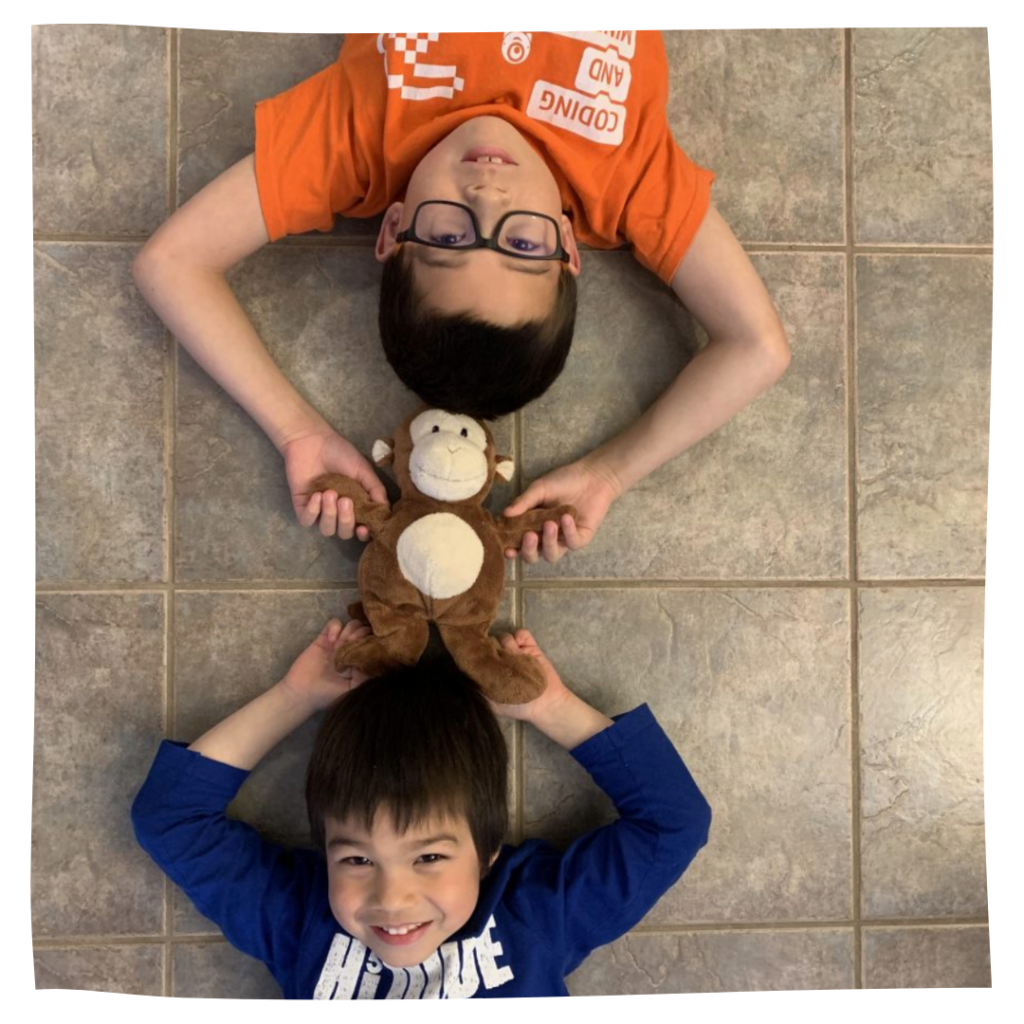
Two boys on the floor practicing the head-to-head rolling technique.

Head to head rolling –

Once again, have 2 people lie on the floor facing the ceiling, with the top of the head facing each other, but with feet in the opposite direction to the other person.  There should be a small gap between the top of their heads.  Everyone keep their arms overhead holding onto a soft toy or piece of fabric.  This activity encourages kids figuring out how to roll without using their arms, which requires additional strength and coordination, as well as team work so they do not lose their grip.  This is more challenging as they cannot see each other so it requires more concentration, communication, and effort to work with their partner.

If you have more than 2 people available, you can try playing Conveyor Belt –

The children and adults lie shoulder to shoulder with a soft toy such as a teddy bear on the belly of the first person.  Each person has to move the teddy bear from the first to the last person only by rolling, without using their hands to help.

While you are playing these fun rolling games, put on some music, like Proud Mary by Tina Turner or Rolling in The Deep by Adele to Roll along with!

A young child playing with an orange toy vacuum clearner.

Heavy work provides calming and organizing sensory input for homebound kids that may or may not be bouncing off the walls with physical distancing and quarantine practices in place right now. At its core, heavy work is any activity that provides input to the muscles and joints, also known as proprioception, typically through resistance activities – push, pull, and carry.

Below are some activities and ideas to get your kids moving and regulated!

These ideas are great to incorporate throughout the day as the regulating effects last up to 2 hours. See Grandview’s Making a Routine blog post for ideas on how add these activities within a routine.

Outdoor heavy work ideas (while practicing physical distancing):

  • Pulling a wagon on a walk with a younger sibling inside.
  • Carry a backpack with some weight inside (e.g., book, food, water). Ensure the backpack is not too heavy (5% body weight is recommended).
  • Washing windows – your child can draw and practice printing/drawing pictures and shapes then wash if off.
  • Playing/digging in the sand box in the backyard.

They are never too young to start with Chores! Chores! Chores!

  •  Vacuuming – if your child can tolerate the noise!
  •  Help with yard work and/or gardening. There are lots of leaves outside to be raked!
  •  Carry small baskets of laundry.
  •  Sweeping or mopping floors.
  •  For older kids, bringing the garbage and recycling to the curb. Make sure they wash their hands after!

Family Fun time with Heavy Work!

  Get creative with obstacles courses!

  • Be a spy and use streamers or string as lasers. Try not to get zapped!
  • Use common household items: jumping off couches onto pillows, climb over/under chairs, walk along a taped line, climb stairs 2 by 2, wheelbarrow walking.
  • Build forts that can be crawled through using pillows and blankets.
  • Tug-of-war using thick blankets, or push-a-war using an exercise ball (try not to get steam rolled!).
  • Kids yoga (https://www.youtube.com/user/CosmicKidsYoga)
  • Squish, knead, and play with Play Doh or silly putty.
  • Animal walks.
See Occupational Therapist Pamela Lam and her dog Boomer demonstrate some animal walks below:
Woman acting out a bear walk motion.
Woman acting out a crab walk motion.
Woman acting out a seal walk motion.
  • ⟨
  • Page 1
  • Interim pages omitted …
  • Page 38
  • Page 39
  • Page 40
  • Page 41
  • Page 42
  • Interim pages omitted …
  • Page 51
  • ⟩

Primary Sidebar

Child Stories

LnRiLWZpZWxke21hcmdpbi1ib3R0b206MC43NmVtfS50Yi1maWVsZC0tbGVmdHt0ZXh0LWFsaWduOmxlZnR9LnRiLWZpZWxkLS1jZW50ZXJ7dGV4dC1hbGlnbjpjZW50ZXJ9LnRiLWZpZWxkLS1yaWdodHt0ZXh0LWFsaWduOnJpZ2h0fS50Yi1maWVsZF9fc2t5cGVfcHJldmlld3twYWRkaW5nOjEwcHggMjBweDtib3JkZXItcmFkaXVzOjNweDtjb2xvcjojZmZmO2JhY2tncm91bmQ6IzAwYWZlZTtkaXNwbGF5OmlubGluZS1ibG9ja311bC5nbGlkZV9fc2xpZGVze21hcmdpbjowfQ==
LnRiLWhlYWRpbmcuaGFzLWJhY2tncm91bmR7cGFkZGluZzowfQ==
ICAudGItaW1hZ2V7cG9zaXRpb246cmVsYXRpdmU7dHJhbnNpdGlvbjp0cmFuc2Zvcm0gMC4yNXMgZWFzZX0ud3AtYmxvY2staW1hZ2UgLnRiLWltYWdlLmFsaWduY2VudGVye21hcmdpbi1sZWZ0OmF1dG87bWFyZ2luLXJpZ2h0OmF1dG99LnRiLWltYWdlIGltZ3ttYXgtd2lkdGg6MTAwJTtoZWlnaHQ6YXV0bzt3aWR0aDphdXRvO3RyYW5zaXRpb246dHJhbnNmb3JtIDAuMjVzIGVhc2V9LnRiLWltYWdlIC50Yi1pbWFnZS1jYXB0aW9uLWZpdC10by1pbWFnZXtkaXNwbGF5OnRhYmxlfS50Yi1pbWFnZSAudGItaW1hZ2UtY2FwdGlvbi1maXQtdG8taW1hZ2UgLnRiLWltYWdlLWNhcHRpb257ZGlzcGxheTp0YWJsZS1jYXB0aW9uO2NhcHRpb24tc2lkZTpib3R0b219IC53cC1ibG9jay1pbWFnZS50Yi1pbWFnZVtkYXRhLXRvb2xzZXQtYmxvY2tzLWltYWdlPSJhMWJlMmUyODAwMWFkMGRlMjBhM2RlZWVlYmE5MDJhMSJdIHsgbWF4LXdpZHRoOiAxMDAlOyB9IEBtZWRpYSBvbmx5IHNjcmVlbiBhbmQgKG1heC13aWR0aDogNzgxcHgpIHsgICAudGItaW1hZ2V7cG9zaXRpb246cmVsYXRpdmU7dHJhbnNpdGlvbjp0cmFuc2Zvcm0gMC4yNXMgZWFzZX0ud3AtYmxvY2staW1hZ2UgLnRiLWltYWdlLmFsaWduY2VudGVye21hcmdpbi1sZWZ0OmF1dG87bWFyZ2luLXJpZ2h0OmF1dG99LnRiLWltYWdlIGltZ3ttYXgtd2lkdGg6MTAwJTtoZWlnaHQ6YXV0bzt3aWR0aDphdXRvO3RyYW5zaXRpb246dHJhbnNmb3JtIDAuMjVzIGVhc2V9LnRiLWltYWdlIC50Yi1pbWFnZS1jYXB0aW9uLWZpdC10by1pbWFnZXtkaXNwbGF5OnRhYmxlfS50Yi1pbWFnZSAudGItaW1hZ2UtY2FwdGlvbi1maXQtdG8taW1hZ2UgLnRiLWltYWdlLWNhcHRpb257ZGlzcGxheTp0YWJsZS1jYXB0aW9uO2NhcHRpb24tc2lkZTpib3R0b219IH0gQG1lZGlhIG9ubHkgc2NyZWVuIGFuZCAobWF4LXdpZHRoOiA1OTlweCkgeyAgIC50Yi1pbWFnZXtwb3NpdGlvbjpyZWxhdGl2ZTt0cmFuc2l0aW9uOnRyYW5zZm9ybSAwLjI1cyBlYXNlfS53cC1ibG9jay1pbWFnZSAudGItaW1hZ2UuYWxpZ25jZW50ZXJ7bWFyZ2luLWxlZnQ6YXV0bzttYXJnaW4tcmlnaHQ6YXV0b30udGItaW1hZ2UgaW1ne21heC13aWR0aDoxMDAlO2hlaWdodDphdXRvO3dpZHRoOmF1dG87dHJhbnNpdGlvbjp0cmFuc2Zvcm0gMC4yNXMgZWFzZX0udGItaW1hZ2UgLnRiLWltYWdlLWNhcHRpb24tZml0LXRvLWltYWdle2Rpc3BsYXk6dGFibGV9LnRiLWltYWdlIC50Yi1pbWFnZS1jYXB0aW9uLWZpdC10by1pbWFnZSAudGItaW1hZ2UtY2FwdGlvbntkaXNwbGF5OnRhYmxlLWNhcHRpb247Y2FwdGlvbi1zaWRlOmJvdHRvbX0gfSA=

Danielle’s story: Autism Acceptance Day – April 2

When all three of my children were diagnosed with Autism Spectrum Disorder, it changed my life in a way I did not expect. My older two children hit every milestone...

Latest Updates

  • Grandview Kids and Lakeridge Health open Canada’s first anesthesia procedure clinic in a Children’s Treatment Centre May 6, 2026
  • Ahaana’s magic ears: Speech and Hearing Month May 5, 2026
  • May: Dates of Significance April 30, 2026
  • Building confidence through the power of giving: Norah’s story April 30, 2026
  • A Place Where S Shines: Williams Syndrome Awareness Month April 29, 2026

You Have Questions

We’d like to help you find the answers…

Contact Us Today

© Grandview Kids Built by PeaceWorks

  • About Us
  • Contact Us
  • Privacy
Accessibility Adjustments

Powered by OneTap

How long do you want to hide the toolbar?
Hide Toolbar Duration
Select your accessibility profile
Vision Impaired Mode
Enhances website's visuals
Seizure Safe Profile
Clear flashes & reduces color
ADHD Friendly Mode
Focused browsing, distraction-free
Blindness Mode
Reduces distractions, improves focus
Epilepsy Safe Mode
Dims colors and stops blinking
Content Modules
Font Size

Default

Line Height

Default

Color Modules
Orientation Modules