• Skip to primary navigation
  • Skip to main content
  • Skip to primary sidebar
Grandview Kids Logo

Grandview Kids

Every Child And Youth Living Life At Their Full Potential

  • About Us
    • Vision, Mission and Values
    • The New Grandview Kids
      • Operational Readiness
      • Visiting Grandview Kids’ Ajax Headquarters
    • Our History
    • Leadership
    • Board of Directors and Committees
      • Join our Board of Directors and Committees
    • Annual Report
    • Strategic Plan
    • Policies
  • Calendar
  • Annual Report
    • Strategic Direction 1: Deliver meaningful, efficient client and caregiver outcomes and experiences
    • Strategic Direction 2: Foster a thriving, connected Team Grandview
    • Strategic Direction 3: Collaborate with partners to maximize impact, focusing on Durham Region
    • The New Grandview Kids – The Jerry Coughlan Building
    • 2024-25 Financial Statement
    • Grandview Kids Foundation update
    • Grandview School update
  • Contact
    • Contactez – nous
    • Ajax – Headquarters
    • Bowmanville Health Centre
    • Grandview School
    • Oshawa – Dwyer
    • Port Perry
    • Whitby – Abilities Centre
  • Careers
  • Register
  • Donate
  • Instagram
  • LinkedIn
  • Facebook
  • Services and Programs
    • Audiology
    • Autism Program
      • Autism Spectrum Disorder (ASD) Diagnostic Hub
      • Caregiver-Mediated Early Years Programs
      • OAP Core Clinical Services
      • Entry to School Program
      • Foundational Family Services
    • Blind-Low Vision Program
    • Extensive Needs Service
    • Family Engagement Program
      • Adolescent Transition Program
      • Family Leader Program
        • Family Advisory Council
        • Youth Advisory Council
    • Infant Hearing Program
    • Medical Services
      • Autism Spectrum Disorder (ASD) Diagnostic Hub
      • Complex Care Program
      • Grandview Anesthesia Procedure (GAP) Clinic
      • Hypertonia Clinic
      • Nutrition Services
      • Orthopaedic Clinic
    • Occupational Therapy
    • Physiotherapy
    • Preschool Outreach Program
    • School Programs & Resources
      • Resources for Educators
      • School-Based Rehabilitation
    • Service Navigation
      • SmartStart Hub: Parents
      • SmartStart Hub: Partners
    • Social Work
    • Speech-Language Pathology
      • Augmentative and Alternative Communication
    • Therapeutic Recreation
  • Purchased Services
    • Summer Camp 2026
    • OAP Core Clinical Services
      • Behaviour Services
  • Research
    • Get involved in research
    • IDEA Study
      • Building knowledge and understanding of the intersection of race and disability in accessing pediatric rehabilitation services.
    • Research Associate: Dr. Fiona Moola
    • Research Associate: Dr. Meghann Lloyd
  • Resources
    • Ability Acceptance Program
    • Arriving at Grandview Kids
    • Community Supports & Resources
    • Family Support Fund
    • Free to Read Program
    • Frequently Asked Questions
    • Gather by Grandview Kids
    • News and Updates
    • Privacy
    • Resources for Parents and Caregivers
    • Visiting Grandview Kids
  • Support Us
    • Ways to support
    • Host a fundraiser
    • Participate in an event
      • Golf Fore Grandview Kids
      • Sponsor the Drum
      • Dream Big, Dream Brighter Awards Gala
    • Leave a legacy
      • Gifts of securities
      • Gifts of bequests
      • Gifts of life insurance
    • Your impact
    • Building a Legacy: Honouring Jerry Coughlan
  • I Want To…
    • Connect with Grandview Kids
    • Donate
    • Refer a child or youth
    • Register via My Community Hub
    • Schedule an Appointment
    • Volunteer at Grandview Kids
    • Work at Grandview Kids
  • Grandview School
    • About Our Program
    • About Our Board
    • Grandview School Social Story
    • Plans and Reports
    • Resources for Families
    • Resources for Schools – Switch It Up!
    • Careers and Volunteering
    • Contact Grandview School
  • Search

Posted July 12, 2021

Develop your child’s social skills through play

Adrian Polidano

Written by Grandview Kids Recreation Therapist, Maddy

Many social skills are developed through play in early childhood. Teaching your child to play and engage with their peers will help them develop friendships and build skills to develop meaningful leisure interests. Grandview Recreation Therapist, Maddy, has created some activity and game suggestions that you can do with your children to encourage social skills and peer-to-peer social communication.

Illustration of three kids jumping on a sandy beach.

These activities and games can be done with siblings, neighbours, and/or other peers close in age to your child. These activities will provide caregivers with an opportunity to encourage their child/children to develop appropriate social skills and peer-to-peer social communication.

Use variations and make modifications as needed.

Tips

  • Provide choices as often as possible.
  • Take breaks as needed.
  • Focus on the child’s strengths. Please encourage them to use their talents. At the same time, identify their challenges and find ways to work on them together.
  • Model how to play the game and use your own play and enthusiasm to promote engagement. You can use hand-over-hand support to help them understand what they need to do in the game.
  • Make sure to clarify when it is my turn vs. your turn. Can use pointing, words, or other visuals if helpful. Learning to take turns in play will support learning how to take turns in social conversations.

Activity List

  • I-Spy/Spot It
  • Play-Doh Guessing Game
  • Simon Says
  • Red Light Green Light
  • Fort Building

I-Spy/Spot It

This activity fosters turn-taking and is a game that requires no toys or equipment. This activity is commonly played in unstructured time with school-aged children.

  1. Use a picture, spot it books, or simply lookout around the room or out a window.
  2. You start by saying: “I spy with my little eye something that is *choose a colour*.”
  3. Wait for your child to guess and keep going until they guess the correct object. Your child can guess using words, pointing, leading, etc.
  4. Take turns going back and forth for as long as your child will tolerate. It may start at 2 minutes, and eventually, you may be able to play for 10-15.

Graphic of a red magnifying glass.

Play-Dough Guessing Game

This activity allows your child to practice theory of mind (the idea that not everyone knows what you know), turn-taking, and creativity.

  1. You will need play-dough or modelling clay. You can also use tools, shapes, cookie cutters, etc.
  2. At a table or flat surface, set out your play-dough. Give lots of choices (colours, tools, etc.).
  3. Set a time limit and tell your child you will make something specific (a food, an animal, a shape, a number, etc.); you can use a visual timer if needed.
  4. Emphasize that what they are making is a secret and that you are playing a guessing game (this can be a challenging concept for many children – practice as much as possible).
  5. When the objects are ready, take turns guessing what you each made.
  6. Can repeat with different categories, shapes, trade materials etc. While building, you can talk about the categories, shapes you’re making, taking turns with materials (“can I use the knife” or “what foods do we like to eat?”).
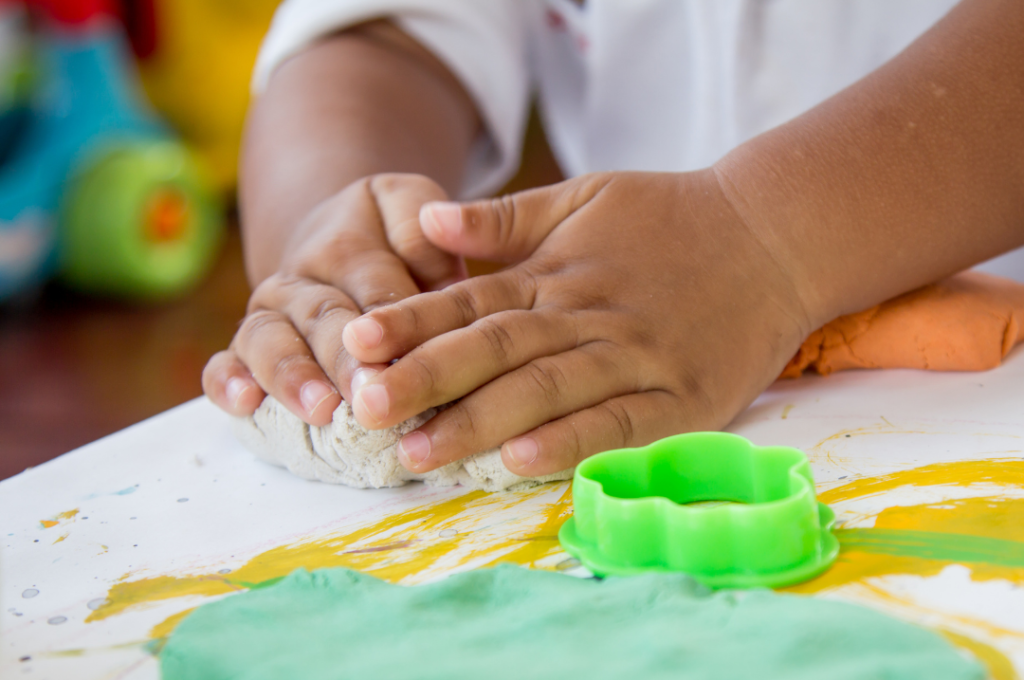
Image of a little child kneading play-dough.

Simon Says

This activity teaches skills commonly seen in group activities in school and recreation programs. Practicing at home might help develop their confidence in group settings.

  1. Explain to your child that you will take turns being “Simon” (it can be any character – Peppa Says, Skye Says, Ryder Says, etc., remember to follow their interests).
  2. Take turns just giving instructions and following the leader “touch your head, jump up and down, etc..”
  3. Once your child is comfortable, you can try adding the official rule; if you don’t start your sentence with “Simon Says,” you do not follow the action (this may be tricky for some children, be patient and practice).
  4. Then allow your child long turns being Simon!

Illustration of a group of kids cupping their ears to listen closely.

Red Light, Green Light

Red Light, Green Light is a great activity to play with a group. This activity helps teach self-regulation and body control in a fun and exciting way.

  1. Start by naming each light and the meaning of each light using modelling (red light = stop, green light = go, yellow light = slow).
  2. To start, you can find an open space and take turns yelling out each light colour.
  3. Once they understand this, you can choose one person to be ‘It.’ The person moves farther away and stands with their back towards the other players. The other players will stand on a line facing the person who is its back.
  4. The person who is it will start calling out “Green Light/Yellow Light” and will turn around and call “Red Light,” trying to catch other players moving.
  5. Take turns being the leader.
  6. If you don’t have a big space to participate in this activity – play on the spot (run on the spot, dance, slow motion on the spot, etc.)
  7. Once they understand the rules, you can add different coloured lights to the activity (purple light = dance, blue light = sit, etc.).

Picture of a black traffic light.

Fort Building

This activity will support pretend/imaginative play while using problem-solving to work cooperatively with you.

  1. This activity involves cooperative play skills, working together as parent and child or child and peer towards a common goal.
  2. Ask your child if the fort should have a theme (Lion’s Den, Mermaid cave, Zoo, house, doctor’s office, castle, etc.)
  3. Discuss what supplies should be used and what aspects of the structure you will need (walls, door, roof, etc.)
  4. Gather supplies together, use blankets, pillows, chairs, and other household items to build your fort
  5. Build a fort together, allow for trial and error, and encourage discussion throughout
  6. Foster continuation of ideas by repeating their statements back to them as questions
    • Your child says, “we need a door that can move,” you reply saying, “oh, we need one that moves?”. This will encourage them to continue their thought process out loud.
    • If they are replying with one-word answers (“yeah” or head nodding), try to elaborate by saying, “We need a door that moves? What could we use that moves?”
  7. Once your fort is built, engage in pretend play – either “house” or follow your child’s theme. Assign roles and play out various scenarios (going to bed, dinner time, getting ready for school, fighting a “bad guy,” etc.).
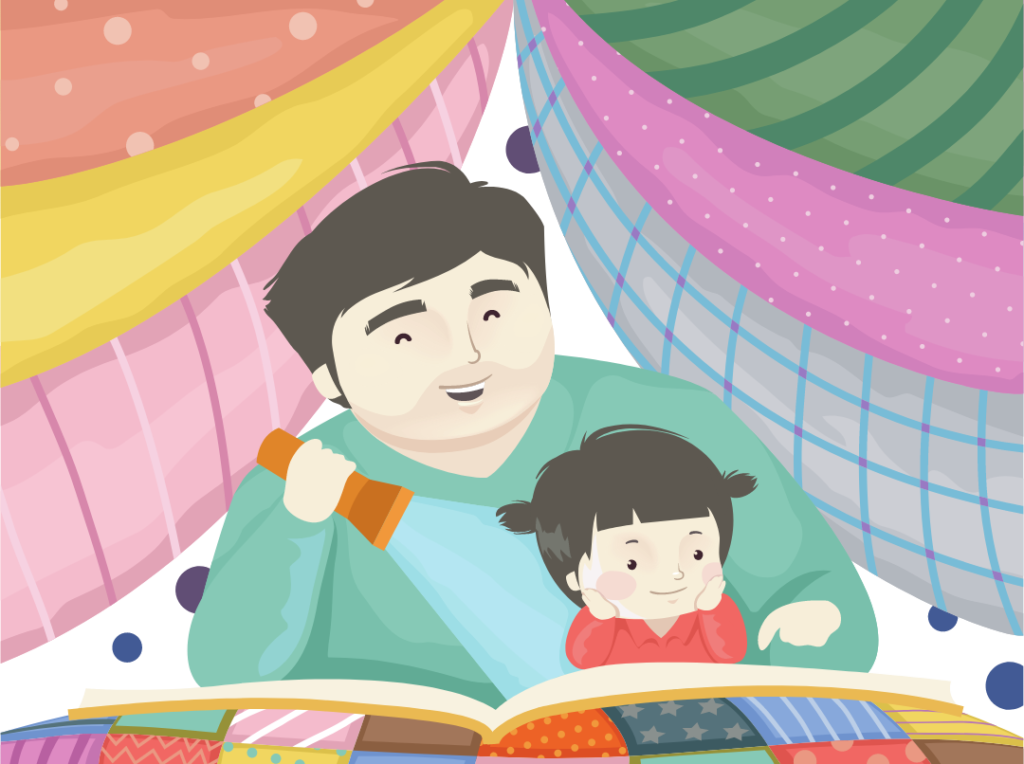
Illustration of dad and daughter reading a book with a flashlight underneath a homemade fort.

Generalization: The importance of changing things up!

Written by Grandview Kids Autism Therapy Assistant Samantha


Generalization in Applied Behaviour Analysis (ABA) is the ability to transfer learned skills to new environments and situations. This could involve learning with new people, learning in a new setting or with new materials.

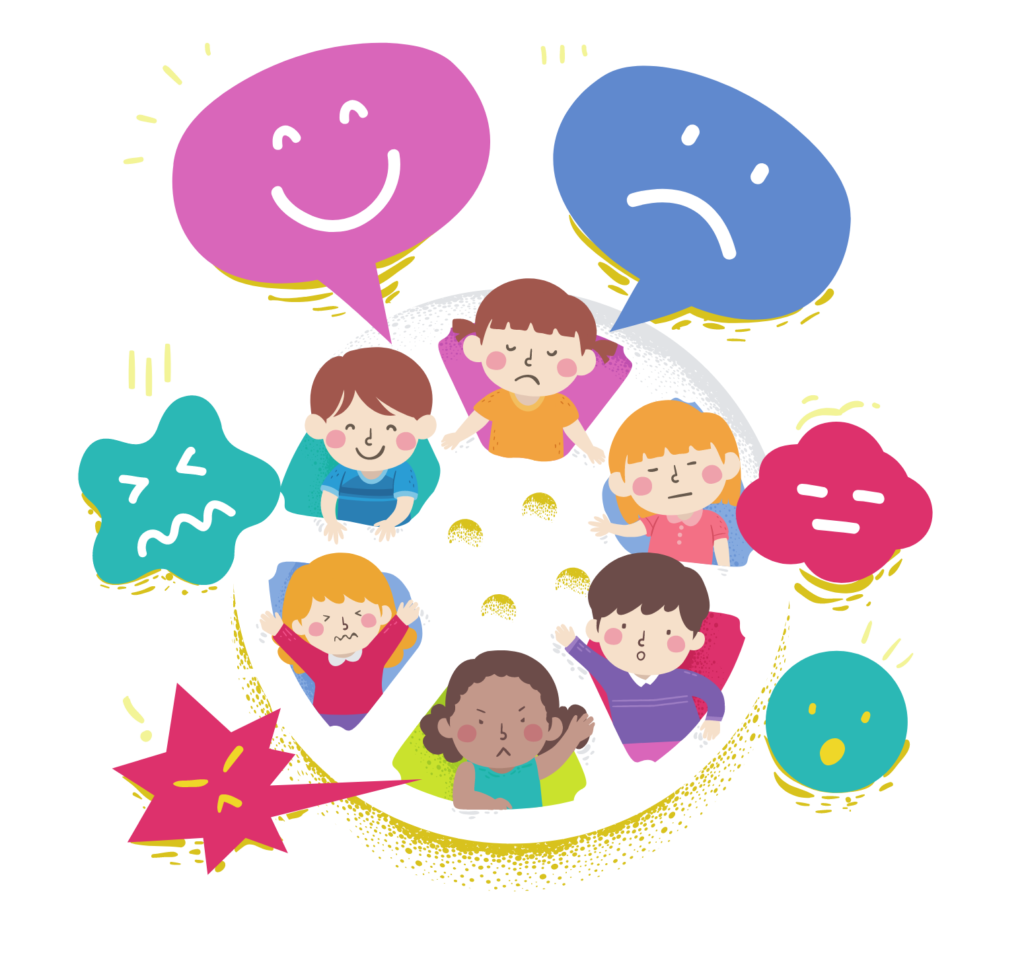
An illustration of 5 children with multicoloured speech bubbles over their heads.

If a child can only tie their shoes if they have specific shoes when they are at home with their parents, what happens when they get a new pair of shoes or are at school with a teacher?

People assume that once a skill is learned, it is learned everywhere; however, this is not the case. This post will explain the importance of generalization in ABA and ways we can incorporate it in our teaching steps as parents and clinicians to make skills last over time!

Why is generalization important?

Children often can complete a specific skill or task in a specific environment where it was initially taught (e.g., in a therapy room with their therapist). Although this may be accepted initially, children should be taught to transfer these skills to different situations and contexts for skills to last over time. This transfer of skills to novel environments ensures that the learner will be able to complete the skills in the natural environment, which in turn allows for more independence.

When should we start teaching generalization?

Parents and clinicians should start incorporating generalization at the beginning of teaching a new skill. It shouldn’t be an afterthought!

An illustration of a little girl wearing a hijab with a thought bubble over her head.

Different ways to promote generalization when teaching

1. Changing up your instructions

If we are teaching a child to sit down when we give an instruction, we may say “come sit,” “go sit,” “sit in your chair,” or “sit at your desk.” Changing up the wording of your instructions allows the child not to get stuck on one instruction as not everyone will say it the same way in their environment.

2. Use different materials

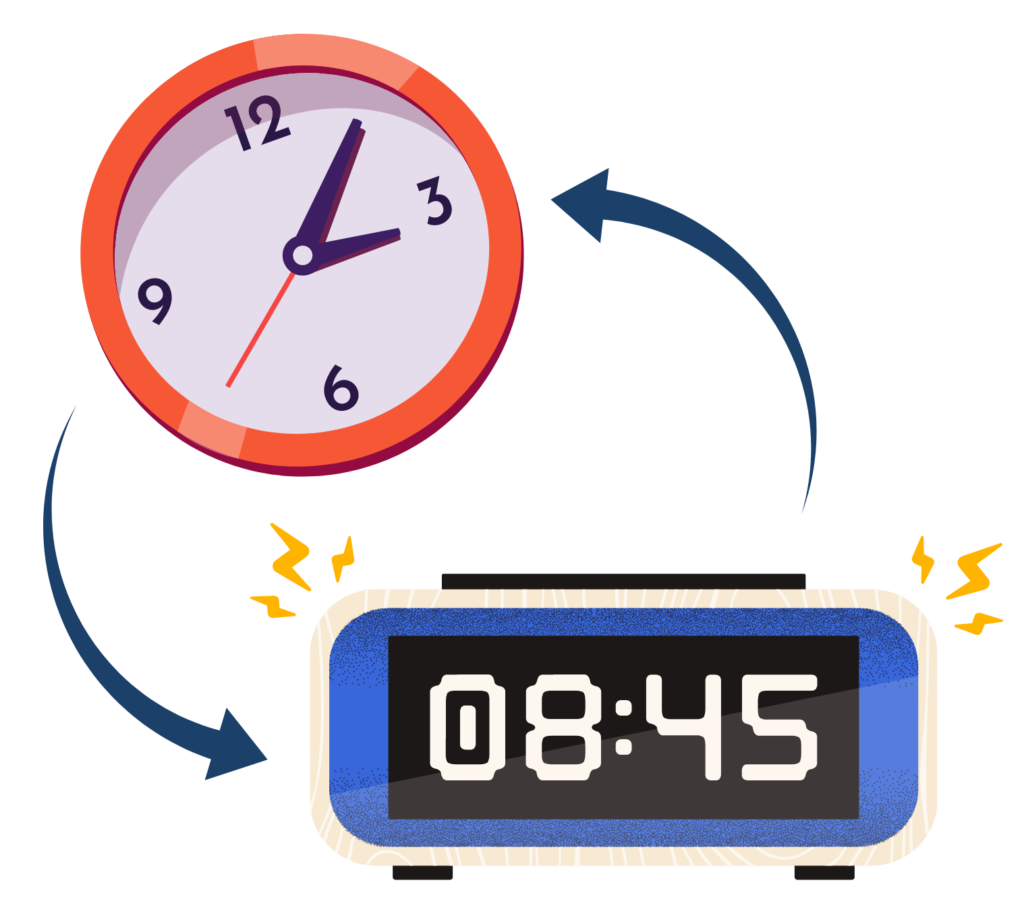
When teaching a child to do up their coat, we may teach them with buttons, zippers and snaps. This allows the child to independently do up their coat no matter what type of coat it is. Another example would be teaching a child to tell time using various digital clocks and a variety of analog clocks. Teaching with various materials allows for the transfer of the skill of time-telling to all kinds of clocks!

Analog and digital clocks side by side showing the differences in how they tell time.

3. Have different people teach the skill

Often children will only complete a skill if it is with their therapist or parent. Switching up the person giving the instruction or being present while completing the skill allows the child to learn the skill with several people.

4. Teach in different settings and locations

Teaching a child to complete skills in different settings allows the child to complete the skill when in different locations independently. For example, if we are teaching a child to go to the bathroom, we want to expose them to various bathrooms (e.g., upstairs bathroom, downstairs bathroom, school bathroom, and public bathrooms).

A graphic of a toilet with a roll of toilet paper hanging nearby.

The importance of generalization

It is vital to change things up when teaching, so children don’t get stuck on doing things in a certain way. Promoting generalization from the beginning of teaching will help children transfer newly learned skills to various new environments and make these skills last over time!

June 25, 2021

Eligible families of children with Autism Spectrum Disorder (ASD) will begin receiving invitations to the Ontario Autism Program (OAP) Caregiver-Mediated Early Years Programs on June 28, 2021.


Today, the Ministry of Children, Community and Social Services (MCCSS) unveiled the agencies offering caregiver-mediated programs in Ontario. In Durham Region, the successful agencies include Grandview Kids, Lake Ridge Community Support Services and The Regional Municipality of Durham. Along with Resources for Exceptional Children and Youth, these agencies make up the Ontario Autism Program, Durham (OAP-D) Partnership.

The OAP-D Partnership will deliver three caregiver-mediated Programs: Social ABCs, Project ImPACT, and The PLAY Project.

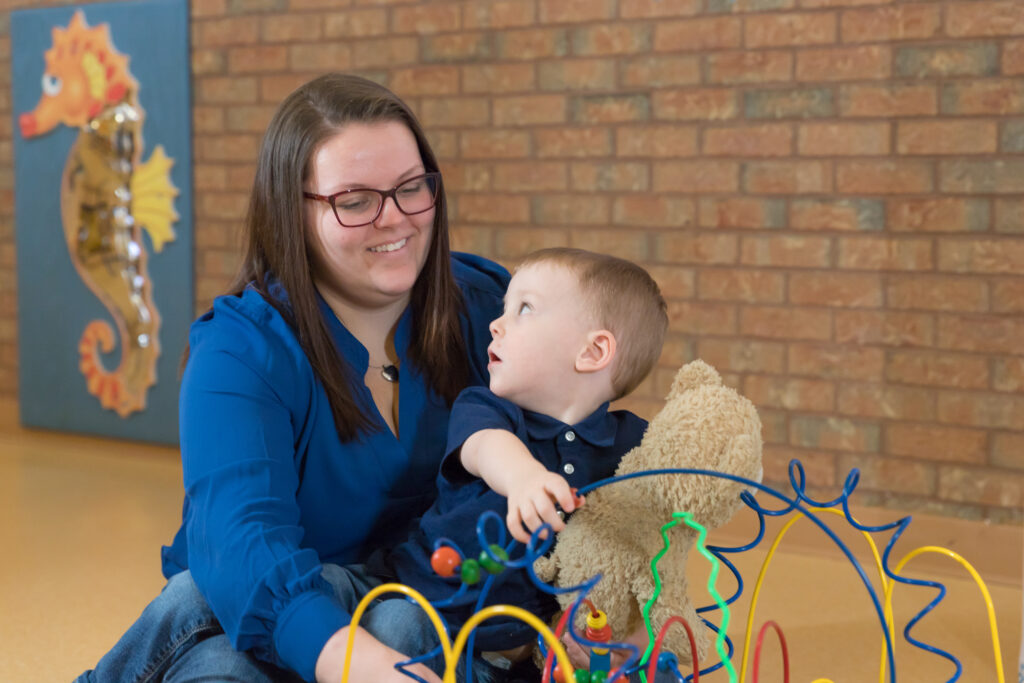
Mother holding son in her lap as he plays with the toys in front of them.

Caregiver-mediated early years programs are play-based and child-led. These programs help young children (12 to 48 months of age) learn new skills and meet individualized goals in their natural environments. Programs are delivered by trained professionals who support parents to learn and apply play-based strategies that foster their child’s skill development. Programs are offered for up to six months, with virtual options available during the COVID-19 pandemic.

Programs are offered as part of a needs-based, sustainable and family-centred OAP led by the MCCSS. The MCCSS will directly invite families to participate via written letter. Grandview Kids will oversee the referral and intake process, and families will select their preferred program. Families may only participate in one program at a time at no cost. 

“We are thrilled to partner with Lake Ridge Community Support Services and The Regional Municipality of Durham to support families of young children with Autism. The addition of caregiver-mediated programs means parents will have improved access and support to help their child reach their full potential.”

Lorraine Sunstrum-Mann, CEO, Grandview Kids

For more information on the Ontario Autism Program, Caregiver-Mediated Early Years Programs, visit the Province of Ontario website and our dedicated Caregiver-Mediated Programs page.

The Ultimate Training Technique!

Written by Grandview Kids Autism Therapy Assistant Samantha


Do you ever wonder what the process is on how we train staff and parents in Applied Behaviour Analysis (ABA)? Well, the most likely answer is by using a technique called Behavioural Skills Training or BST.

Behavioural Skills Training is broken down into four parts: instruction, modelling, practice/rehearsal and feedback.

Instruction

Instruction refers to telling the parent or trainee what to do and explaining why we do it. Too often, people stop at this step or do not explain the why behind our actions. Adequate training involves more than just the explanation! Parents and trainees need to understand the reasoning behind why we do certain things instead of just telling them, “you need to do it this way.”

Modelling

Modelling refers to the clinician modelling or showing the parent/trainee what to do. This step should be completed in the natural environment with the client or your child when possible. For example, if a clinician is training you on effectively transitioning your child into the school, the clinician would model the skill during a regular transition. This allows you to see the skill in action! However, if modelling in the natural environment is not possible, you can perform role-play scenarios!

Practice/Rehearsal

Practice makes perfect! This is the most important step, as this is where the trainee or parent gets to practice the skill they just learned. Similar to the modelling step, this step should also be completed in the natural environment when possible. It allows trainees to experience it like they would in a real situation.

Feedback

Feedback is when the clinician gives the trainee or parent some immediate feedback on what they did correctly and what they need to improve. Feedback should be immediate, so the trainee can fix it right away and keep practicing! This also allows the parent or trainee to ask questions if they need clarifications.

Other Uses of BST:

Behavioural Skills Training can also be effective for teaching skills to children! Some examples of skills that can be taught using BST are:

  • Accepting outcomes of games (winning/losing appropriately)
  • How to interrupt a conversation
  • Safety skills (e.g., what to do if you are lost)

Understanding your child’s behaviour

Written by Grandview Kids Autism Therapy Assistants Dana and Yogeetha


Parents and caregivers are encouraged to seek the support of a professional trained in Applied Behaviour Analysis (ABA) if their child is engaging in challenging behaviour that is causing harm to themselves or others and/or maybe impacting their ability to access various environments experiences.

Behaviour is anything a living thing does… eating…. breathing…. walking…. reading…. crying… these are all human behaviours. Unfortunately, many parents struggle to manage challenging behaviour with their child (example: kicking, hitting, yelling). As a parent, you may be thinking, should I ignore the behaviour and hope it stops? Should I use time-outs? Why isn’t my discipline working?

Here are some tips to guide and assist with better understanding your child’s challenging behaviour. 

The ABC’s of Behaviour

All behaviours have a function or reason for occurring. Collecting ABC data and reviewing the findings will help modify our approach to change the behaviour.

Scenario: Billy is at the grocery store with his parents. He asks for a candy bar. His parents say “no” as he will be having dinner soon. Billy throws a tantrum by crying and flopping on the floor.  To stop the tantrum, the parents give him a candy bar.

A is the antecedent. This refers to what happens BEFORE the behaviour occurs.

Example: Billy asks for candy bar.

B is the behaviour. This refers to any action that can be SEEN or HEARD following the antecedent. What is the child doing?

Example: Billy throws a tantrum by crying and flopping to the floor.

C is the consequence. This refers to what happens AFTER the behaviour occurs. 

Example: Billy is given the candy bar. Billy stops crying.

Remember all behaviours have a function! What is maintaining the behaviour or keeping it going? In order to answer this question, we will look at the 4 functions of behaviour: 

1. Access to tangibles

Wanting to gain access to a specific item or activity. 

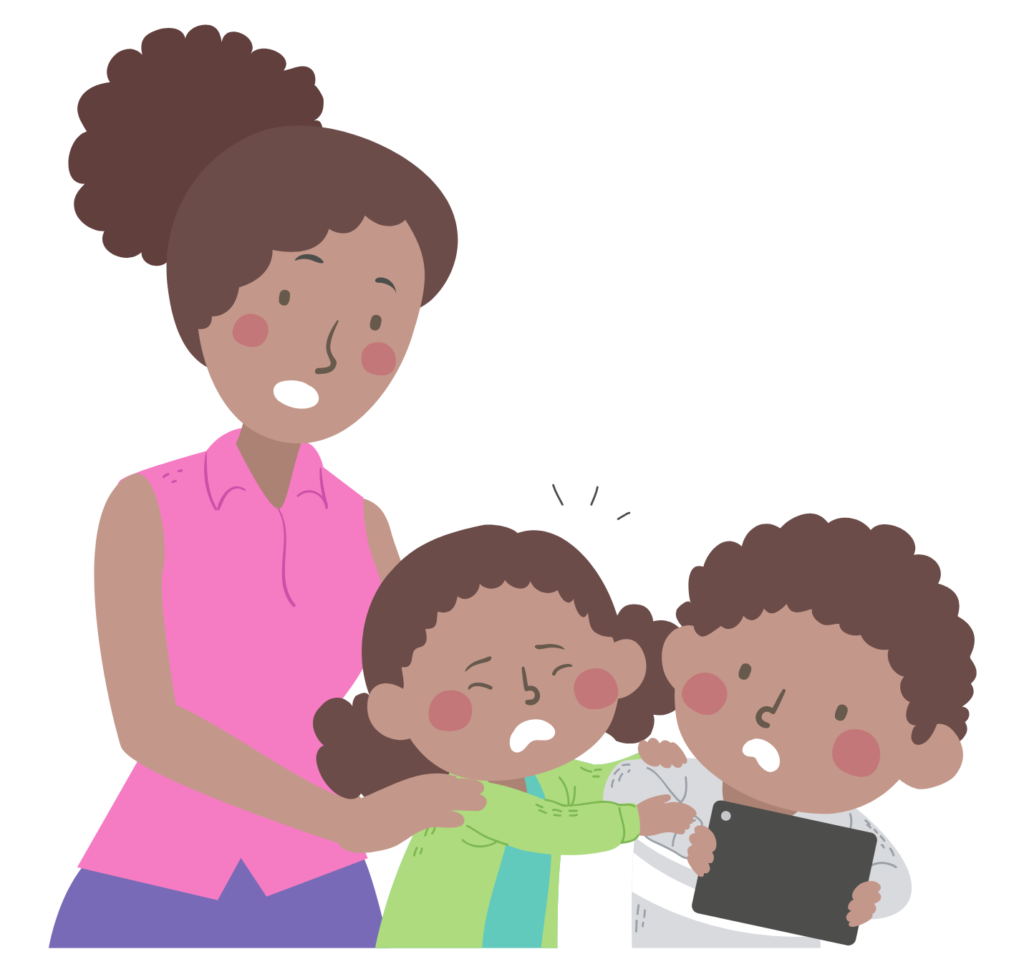
Example: Child may cry and scream as a way of requesting or wanting access to the iPad. If crying/screaming allows the child to access the iPad, this behaviour may continue to occur.  

Tips:
  • Teach an appropriate way to request by labelling or pointing to the item
  • Model appropriate requesting

2. Attention

Wanting to gain someone’s attention or seeking social interaction.  

Example: Child may cry whenever the parent is on the phone. If the parent stops and attends to the child after exhibiting this crying behaviour, then crying may continue to occur in the future.

Tips:
  • Teach a more appropriate way to gain attention by tapping on one’s shoulder or saying one’s name
  • Provide positive attention throughout the day

3. Escape/Avoidance

Wanting to escape/avoid an undesirable task or demand. 

Example: The child may run away or avoid doing homework by putting their head down on the table. If the task is removed after the child engages in these behaviours, these behaviours may continue to occur when the demand is placed.

Tips:
  • A child may be trying to escape/avoid a certain task because it may be too difficult. Providing easier tasks can help mitigate escape/avoidance behaviours.
  • A child may also lack motivation for completing a certain task, so finding ways to make it fun and exciting can be helpful.
  • Always follow through with demands!

4. Sensory/ Self-stimulatory behaviours

Performing actions and behaviours that feel good to oneself which does not have any motivating external factors.

Example: Child rocking back and forth, engaging in hand flapping, hitting one’s head.

Tips:
  • Replace inappropriate behaviour with appropriate/functional behaviour. Ex. Reinforcing clapping hands vs. hand flapping.
  • Reinforce absence of behaviour or when the child engages in a behaviour that is incompatible with the problem behaviour (behaviours that can’t occur simultaneously). Ex. Reinforcing hands on lap vs. hand flapping.

Identifying the ABC’s of behaviour and the four functions of behaviour can provide us with a better understanding and insight into why a child behaves the way they do. This can also allow us to prevent future occurrences of problematic behaviours and increase socially appropriate behaviours.

Written by Grandview Kids CEO, Lorraine Sunstrum-Mann


Grandview Kids is grieving with Muslim staff, colleagues, clients and families.

In the wake of the horrific hate-filled murders in London, Ontario, Grandview stands beside and with Muslims across Canada in denouncing the hatred and racism directly.

Hopes, prayers, and tears will not address anti-Muslim racism.

I have pondered what I can possibly do as one person to make a difference. I have decided that I can continue to choose love over hate. I commit to denouncing racism when confronted by it, calling out racist jokes or comments, not looking the other way, noticing hatred and calling it out, standing with and for equity deserving communities.

No one is born hating. It is learned. It is radicalized. How does a 20-year-old become so filled with hatred? Certainly not overnight. I cannot imagine that there are not people who saw this hatred being fuelled and looked away. I will not look away.

I had the pleasure of serving on the PCMCH Board with Javeed Sukhera MD Ph.D., who is a Paediatric Psychiatrist out of London, Ontario. He is Muslim. He has educated me. Today he asks us not to look away from the hatred that lives within our midst. Do not give it oxygen; starve it with love and suffocate it with compassion. 

Madiha was pursuing her Ph.D. in Geo-environmental Engineering at Western University. Through her writings, she aimed to promote a positive image of the Muslim community, particularly in North America and inspire and motivate the Muslim Youth. Her son now lies in a hospital bed, facing a future without his family. May her writings pave the way for him to see her dream realized: love and compassion.

– Lorraine Sunstrum-Mann, Grandview Kids CEO

  • ⟨
  • Page 1
  • Interim pages omitted …
  • Page 27
  • Page 28
  • Page 29
  • Page 30
  • Page 31
  • Interim pages omitted …
  • Page 51
  • ⟩

Primary Sidebar

Child Stories

LnRiLWZpZWxke21hcmdpbi1ib3R0b206MC43NmVtfS50Yi1maWVsZC0tbGVmdHt0ZXh0LWFsaWduOmxlZnR9LnRiLWZpZWxkLS1jZW50ZXJ7dGV4dC1hbGlnbjpjZW50ZXJ9LnRiLWZpZWxkLS1yaWdodHt0ZXh0LWFsaWduOnJpZ2h0fS50Yi1maWVsZF9fc2t5cGVfcHJldmlld3twYWRkaW5nOjEwcHggMjBweDtib3JkZXItcmFkaXVzOjNweDtjb2xvcjojZmZmO2JhY2tncm91bmQ6IzAwYWZlZTtkaXNwbGF5OmlubGluZS1ibG9ja311bC5nbGlkZV9fc2xpZGVze21hcmdpbjowfQ==
LnRiLWhlYWRpbmcuaGFzLWJhY2tncm91bmR7cGFkZGluZzowfQ==
ICAudGItaW1hZ2V7cG9zaXRpb246cmVsYXRpdmU7dHJhbnNpdGlvbjp0cmFuc2Zvcm0gMC4yNXMgZWFzZX0ud3AtYmxvY2staW1hZ2UgLnRiLWltYWdlLmFsaWduY2VudGVye21hcmdpbi1sZWZ0OmF1dG87bWFyZ2luLXJpZ2h0OmF1dG99LnRiLWltYWdlIGltZ3ttYXgtd2lkdGg6MTAwJTtoZWlnaHQ6YXV0bzt3aWR0aDphdXRvO3RyYW5zaXRpb246dHJhbnNmb3JtIDAuMjVzIGVhc2V9LnRiLWltYWdlIC50Yi1pbWFnZS1jYXB0aW9uLWZpdC10by1pbWFnZXtkaXNwbGF5OnRhYmxlfS50Yi1pbWFnZSAudGItaW1hZ2UtY2FwdGlvbi1maXQtdG8taW1hZ2UgLnRiLWltYWdlLWNhcHRpb257ZGlzcGxheTp0YWJsZS1jYXB0aW9uO2NhcHRpb24tc2lkZTpib3R0b219IC53cC1ibG9jay1pbWFnZS50Yi1pbWFnZVtkYXRhLXRvb2xzZXQtYmxvY2tzLWltYWdlPSJhMWJlMmUyODAwMWFkMGRlMjBhM2RlZWVlYmE5MDJhMSJdIHsgbWF4LXdpZHRoOiAxMDAlOyB9IEBtZWRpYSBvbmx5IHNjcmVlbiBhbmQgKG1heC13aWR0aDogNzgxcHgpIHsgICAudGItaW1hZ2V7cG9zaXRpb246cmVsYXRpdmU7dHJhbnNpdGlvbjp0cmFuc2Zvcm0gMC4yNXMgZWFzZX0ud3AtYmxvY2staW1hZ2UgLnRiLWltYWdlLmFsaWduY2VudGVye21hcmdpbi1sZWZ0OmF1dG87bWFyZ2luLXJpZ2h0OmF1dG99LnRiLWltYWdlIGltZ3ttYXgtd2lkdGg6MTAwJTtoZWlnaHQ6YXV0bzt3aWR0aDphdXRvO3RyYW5zaXRpb246dHJhbnNmb3JtIDAuMjVzIGVhc2V9LnRiLWltYWdlIC50Yi1pbWFnZS1jYXB0aW9uLWZpdC10by1pbWFnZXtkaXNwbGF5OnRhYmxlfS50Yi1pbWFnZSAudGItaW1hZ2UtY2FwdGlvbi1maXQtdG8taW1hZ2UgLnRiLWltYWdlLWNhcHRpb257ZGlzcGxheTp0YWJsZS1jYXB0aW9uO2NhcHRpb24tc2lkZTpib3R0b219IH0gQG1lZGlhIG9ubHkgc2NyZWVuIGFuZCAobWF4LXdpZHRoOiA1OTlweCkgeyAgIC50Yi1pbWFnZXtwb3NpdGlvbjpyZWxhdGl2ZTt0cmFuc2l0aW9uOnRyYW5zZm9ybSAwLjI1cyBlYXNlfS53cC1ibG9jay1pbWFnZSAudGItaW1hZ2UuYWxpZ25jZW50ZXJ7bWFyZ2luLWxlZnQ6YXV0bzttYXJnaW4tcmlnaHQ6YXV0b30udGItaW1hZ2UgaW1ne21heC13aWR0aDoxMDAlO2hlaWdodDphdXRvO3dpZHRoOmF1dG87dHJhbnNpdGlvbjp0cmFuc2Zvcm0gMC4yNXMgZWFzZX0udGItaW1hZ2UgLnRiLWltYWdlLWNhcHRpb24tZml0LXRvLWltYWdle2Rpc3BsYXk6dGFibGV9LnRiLWltYWdlIC50Yi1pbWFnZS1jYXB0aW9uLWZpdC10by1pbWFnZSAudGItaW1hZ2UtY2FwdGlvbntkaXNwbGF5OnRhYmxlLWNhcHRpb247Y2FwdGlvbi1zaWRlOmJvdHRvbX0gfSA=

World Teen Mental Wellness Day – March 2

Sam Keane is a former Grandview Kid’s client and current Grandview Kid’s employee working on the Family Engagement Team as a Peer Navigator. He has Spastic Triplegia Cerebral Palsy and,...

Latest Updates

  • International Pride Day Resources June 26, 2026
  • Herman Kassinger Foundation Establishes $100,000 Endowment Fund at Grandview Kids  June 15, 2026
  • June: Dates of Significance June 1, 2026
  • Becoming her own advocate: Zoey’s story May 29, 2026
  • The life that never was: grieving the fatherhood I thought I’d have May 29, 2026

You Have Questions

We’d like to help you find the answers…

Contact Us Today

© Grandview Kids Built by PeaceWorks

  • About Us
  • Contact Us
  • Privacy
Accessibility Adjustments

Powered by OneTap

How long do you want to hide the toolbar?
Hide Toolbar Duration
Select your accessibility profile
Vision Impaired Mode
Enhances website's visuals
Seizure Safe Profile
Clear flashes & reduces color
ADHD Friendly Mode
Focused browsing, distraction-free
Blindness Mode
Reduces distractions, improves focus
Epilepsy Safe Mode
Dims colors and stops blinking
Content Modules
Font Size

Default

Line Height

Default

Color Modules
Orientation Modules