Elysha, a teacher, and Tyrone, an electrician, are the parents of Adaline (7) and her younger sister, MaKinleigh (3). They built a life that is busy, loud and full of movement, just the way their daughter Adaline likes it. Between outdoor adventures, time at the park, weekends at their cottage and their new trailer, the family is always on the go. Adaline thrives in that energy, seeking out stimulation and excitement, sometimes in ways that keep her parents on their toes!
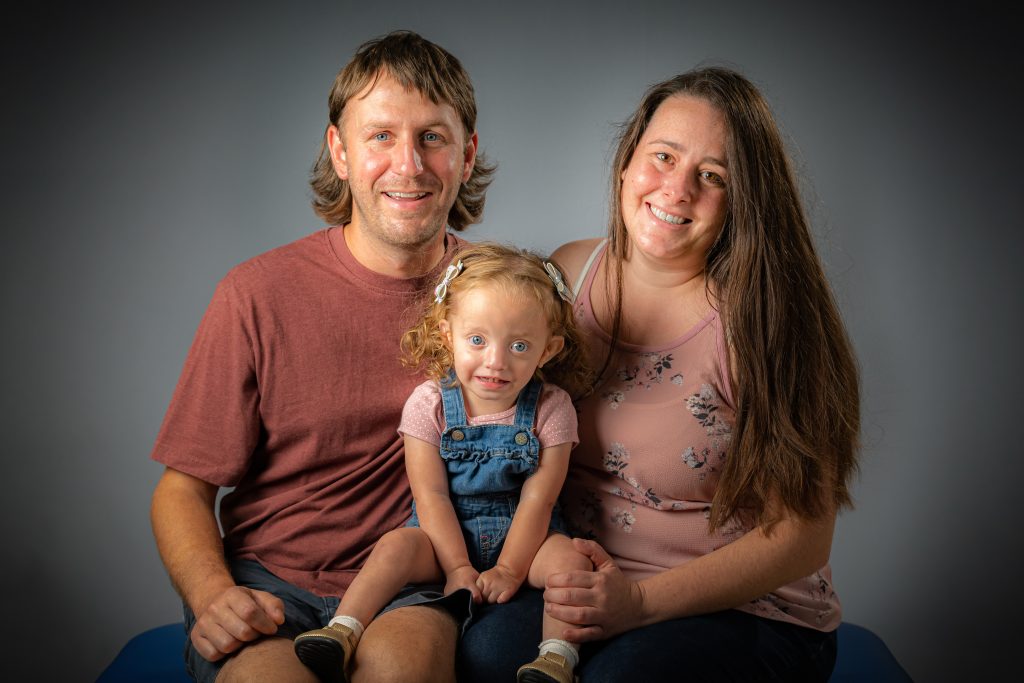
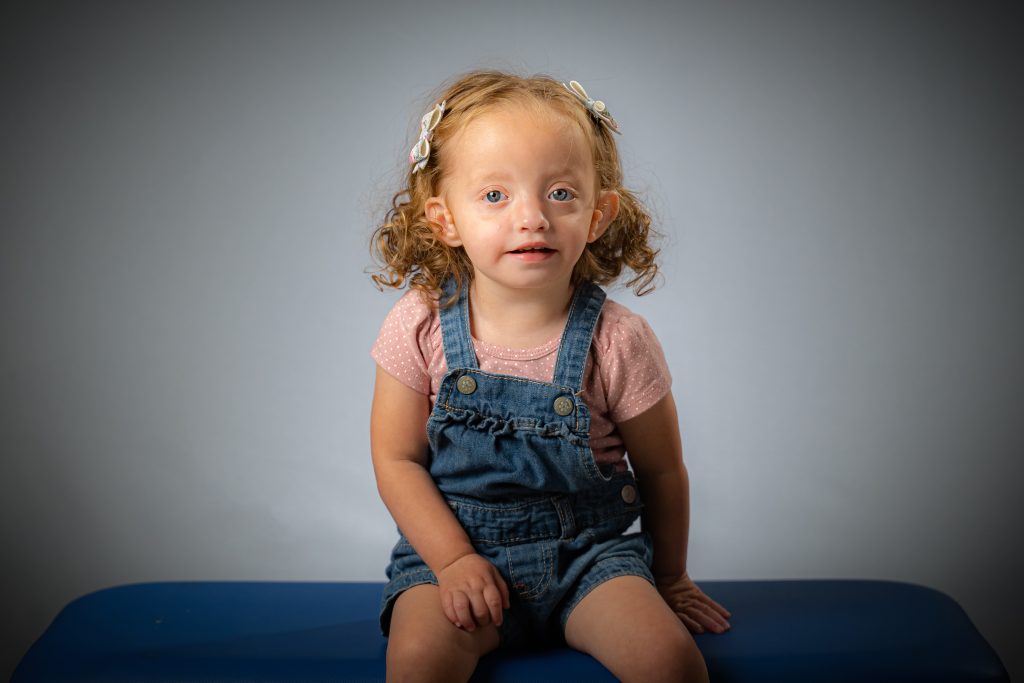
Adaline is a thrill-seeker with no fear. She loves swimming, spinning chairs, loud noises and anything fast, especially Sea-Doos, snowmobiles and even the lawn tractor. Her personality is unmistakably spicy, determined and full of joy. Adaline communicates in her own ways through her expressive eyes, cheeky smile and a signature eyebrow raise that signals either excitement or a bit of mischief. She is clever and bright, and above all, incredibly tenacious. She continues to push past the expectations set for her.
Adaline was one month old when she was diagnosed with Wolf-Hirschhorn Syndrome (WHS), a rare genetic disorder caused by a deletion on chromosome 4. Even within her first week of life, doctors had their suspicions as she was born very small. She was only 3 pounds 13 ounces at nearly 37 weeks gestation, and had difficulty feeding. Subtle physical indicators, including slightly wider-set eyes, small skin growths near her ears and indentations around her shoulders and face, raised concern. She also experienced brain bleeds, adding to the complexity of her early medical picture. Elysha and Tyrone agreed to genetic testing and were told to expect a diagnosis with much milder effects, but when the results arrived, they felt blindsided.
Adaline’s WHS diagnosis came on the very day they were preparing to leave the hospital’s neonatal intensive care unit (NICU), completely changing their path forward. They grieved the life they had imagined, feeling fear and deep uncertainty about the future. For many children with WHS, challenges can include developmental delays, feeding difficulties, seizures, heart defects and hearing, vision, immune and muscle tone differences. Each child’s experience with WHS is unique.
Adaline’s early years were medically intense. She spent 28 days in the NICU and had repeated hospitalizations. For the first year and a half, the hospital became a second home. Feeding was one of the biggest struggles as she required a nasogastric (NG) tube and vomited frequently due to a submucosal cleft palate. Shortly after Adaline came home from the NICU, Tyrone and Elysha were set to be married in May of 2019. At the time she was combo feeding with bottles and through the NG tube. “We really wanted to see Adaline’s beautiful face without the NG tube in our wedding photos as the tape from her NG covered half of her face. Her paediatrician said we could remove it for a few days and put it back in after the wedding.” Adaline had done well without the tubes and continued to maintain her weight that a few days after their wedding, their paediatrician approved the complete removal of the NG tube. She was monitored across multiple specialties, including cardiology, immunology, ear, nose, and throat (ENT) and ophthalmology. Her immune system was fragile, requiring the family to live in a small, protective bubble. The risk of seizures loomed constantly. It was not a question of if she would begin having them, but when. At 15 months old, that fear became reality.
Adaline’s seizures were severe and often triggered by illness or low oxygen levels, caused by choking and aspirating. Most episodes required hospitalization and emergency interventions, like intubation. These moments were terrifying and, at times, traumatic. Over time, Elysha and Tyrone learned not only how to respond but also how to guide medical professionals unfamiliar with Adaline’s rare condition. Since WHS presents differently in every child, they became her experts, voice and advocates.
Today, Adaline’s seizures are better controlled with the help of seizure medication and parental vigilance. Her last major one was in February 2025, and for the first time, it did not require a hospital stay. It was a milestone that reflected years of persistence, learning and advocacy.
Despite everything, Adaline continues to defy expectations. Skills that specialists once thought unlikely, she has achieved through sheer determination. From the very beginning, Grandview Kids became a cornerstone of support for Adaline and her family. Referred shortly after leaving the hospital, she began services at three months old.
At Grandview Kids, the family accessed coordinated care including developmental paediatrics, physiotherapy, occupational therapy, speech-language pathology, therapeutic recreation, nutrition and social work services. Blocks of therapy taught Elysha and Tyrone essential early intervention strategies to guide Adaline’s progress and even led her to independent walking, something that was once considered impossible.
During her most fragile years, Adaline’s family was part of Grandview Kids’ Complex Care Program. This coordinated care team of Adaline’s specialists from Grandview Kids, The Hospital for Sick Children (SickKids), Lakeridge Health and the Ontario Health at Home, Central East, was impactful. This team understood Adaline as a whole child. When her seizures were severe, the team helped fast-track interventions and ensured seamless communication between specialists. They became a central hub for her care.
The community they experienced at Grandview Kids was also profound. At Grandview Kids, Elysha and Tyrone connected with many other families, forming strong friendships and a shared understanding. Grandview Kids Summer Camp and Family Engagement Program events gave Adaline space to discover and belong. Adaline was also fortunate to attend Grandview School to prepare the family for her transition to the mainstream school system. The gratitude Elysha and Tyrone have for the Grandview Kids community they formed is immeasurable.
Today, Adaline’s biggest challenge is communication. She is considered pre-verbal, with a handful of spoken words and some gestures. While her receptive language is strong, understanding much of what is said to her, expressing herself can be frustrating. This gap often shows up in her behaviour. Without a reliable way to communicate her needs, emotions can escalate quickly. Her family continues to explore tools like augmentative and alternative communication (AAC) devices, though attention, vision and motor challenges add complexity.
Transitions, like starting mainstream school this year, have also been difficult. Everyday activities, like eating, still require patience and creativity. Through it all, Adaline continues to grow on her own timeline. Elysha and Tyrone’s journey has taught them lessons they now share openly with other families.
Elysha and Tyrone’s lessons:
Don’t compare.
Comparison is the thief of joy. Every child, diagnosis or not, has their own path. Adaline’s journey cannot be measured against anyone else’s, not even her sister’s.
Be patient and take it day by day.
At first, thinking too far ahead felt impossible. Focusing on the present day-to-day steps, made it manageable.
Celebrate the “inchstones.”
Every victory matters. What may seem minor to others can be monumental for your child.
Advocate fiercely.
You will become the expert on your child. Ask questions, speak up and challenge kindly when needed. Doctors do not have all the answers, especially with rare conditions. They are also learning with and from you.
Find your community.
Whether it is through support groups, organizations like Grandview Kids or other families with different diagnoses but shared lived experiences, connection matters. You are not alone.
Don’t lose sight of joy.
Life may look different. It may involve more planning, equipment and confusion, but it can still be full of fun, laughter and meaningful moments.
Though the future remains uncertain, what has changed is how Elysha and Tyrone face that uncertainty. They now have resilience, community and shared understanding that Adaline will continue to surprise them. If there is one thing Adaline has shown from the start, it is that she is writing her own story.
Check out more Grandview Kids articles
- Defying expectations: Adaline’s journey with Wolf-Hirschhorn Syndrome
- Understanding Autism through Jack’s eyes
- A family’s journey of growth, advocacy and belonging
- National Siblings Day – April 10
- Listening, learning and supporting: Jake’s journey